
On the Scale SEE Podcast I went through my path from IT technician at Telenor to co-founding Secfix and Skenify. We talked about staying calm under pressure, the failures behind Skenify's pivot, why startups should not leave security for later, and how I lead teams.

Scale SEE Podcast with Branko Džakula
I got into cybersecurity by accident
Computer science always interested me, but I was not aware of cybersecurity at all. At university only one subject touched on cryptography, and nobody presented security as an industry or a job.
Montenegro had a programme in which the government paid you a small salary for nine months to work at a company, and the best students could choose where to go. I got Telenor, where I started as an IT technician who fixed printers and set up devices for new employees.
There I met the man who ran information security, a very rare role in Montenegro around 2012. I knew nothing about it and was very curious, so I kept asking him questions until I was fully immersed. He was my mentor and the reason I entered this field.
From Kaia Health to my own companies
I always wanted my own company, but the ideas came only at my first startup, Kaia Health in Munich, where I was among the first ten employees. Digital healthcare is highly regulated, so they needed someone to build the entire compliance programme for cybersecurity and privacy, which I had never done before.
The founders were building AI features before AI was popular. I asked them about the books they read, how they ran things and how they solved problems, until I knew enough to try myself when the timing was right.
The decisive moment came with the pandemic. I moved from Munich to Belgrade, got married and had a child, and within a month two opportunities opened up. A friend from DevTech called with a chance to spin off a cybersecurity services company from a bigger group in the Netherlands, and UN1QUELY started. Around the same time Fabiola posted on LinkedIn that she was looking for a cybersecurity consultant. On the call with her and Grigory we understood each other at once. I started as a part-time consultant, and that quickly turned into an offer to become the third co-founder of Secfix.
When everything is burning, stay calm
In cybersecurity you are a fire department in a digital environment, and in an incident seconds matter. Panic only makes things worse. Stoicism is the best philosophy for my work, because it trains you to keep a cool head, and I now practise it in the rest of my life too.
You have to be the calm voice in the room, because you need clarity: concrete information, who is responsible for what, and a picture of the problem. The same goes for business. Early on, an angry customer can break a startup, so I treat it as a top-level incident, calm the customer and my people down, and talk only about the solution.
What matters most is how a co-founder behaves in these moments. If you bring panic or point fingers, you will lose people and customers.
Skenify: two years of failures before the pivot
We started Skenify with three co-founders from cybersecurity and an automated open-source intelligence platform for investigative journalists, security agencies and HR background checks. Nothing from that product survived the pivot, including its name.
Investors and accelerators told us the market was not big enough, and both co-founders left, one after the other. We spent most of about 100k from a mix of grant and angel investment without making the technology do what we wanted. The team was part of the problem, because all of us had the same skills when we needed different ones.
Then I brought in someone I had worked with before. Our skills complement each other. I bring the vision, the cybersecurity expertise and the go-to-market skills, and he runs the entire product. Little was left of the grant, but my other businesses were doing well, so I reinvested that money and bootstrapped Skenify.
Many failures led to my few successes, and one success is enough. Failing more often than you succeed is a normal part of building something, as long as you learn from each failure.
Five days by the sea
For the pivot we locked ourselves in at my place in Montenegro for five days to plan two years ahead. We spent most of the time at the beach, over coffee and on walks, with him on a bicycle and me running next to him. We needed that time, because co-founder fit decides whether a company survives. As Y Combinator says, most companies die by suicide, and that always comes down to the founders. On the terrace everything fell into place in a few minutes, and we had the name, the vision and a first wireframe.
At Secfix we do the same with the whole team at least once a year, because in a fully remote company time spent together in person is very important.
Startups ignore security when it is easiest
Startups ignore security as a whole, and I cannot understand it, because early on it takes so little effort. When you set up your tools and accounts you need one or two extra steps, such as two-factor authentication, sharing and encryption settings, or an open-source tool in your pipeline. These are usually free. The first tier of Microsoft's Founders Hub gives you a year of GitHub Enterprise, whose static code analyser checks everything you push.
If you leave it for two or three years, fixing security means architectural changes that can cost a lot, break things or delete data. You can ask AI for help today, so there is no excuse for waiting.
A few weeks before the podcast, a very successful HR startup that automates recruitment had a major data breach that exposed recorded calls, interviews and background checks. They had the resources to fix it earlier, so it comes down to priorities. When a company at that stage loses the trust of the market, it usually dies or is sold for very little.
My day is dictated by the needs of other people
My most important job is being a dad. I also run, so I train first thing in the morning and let an app plan the training, because so many things change my calendar that I cannot keep routines.
Between the companies, I prioritise by what is burning and delegate the rest. My calendar stays open so that anyone can reach me on Slack. Nobody should feel that I am too busy, and interrupting me is part of their job. I am there to serve the team, and the people you hire should be better than you at what you hire them for. Afternoons and evenings are family time, and that is where my energy comes from.
When three meetings clash
If Secfix investors, a Skenify customer and someone from The Security Company all need me at once, I go where my absence would do the most damage. The customer then gets the next best person, and I call them myself afterwards. That is why you have to give people authority, so that each of them can replace you in one part of your job.
Optimism and transparency
Optimism is very important and very overlooked. Before a big deal with a low chance of winning, I tell the team that we are going to win it, and that it is fine if we do not. You accept the worst case as if it had already happened and then give everything, because you have nothing to lose.
The other thing I rely on is transparency. I experienced corporate scare tactics myself and do not want to lead that way, so I am open with my team, and I give every person I hire full trust from the first day.
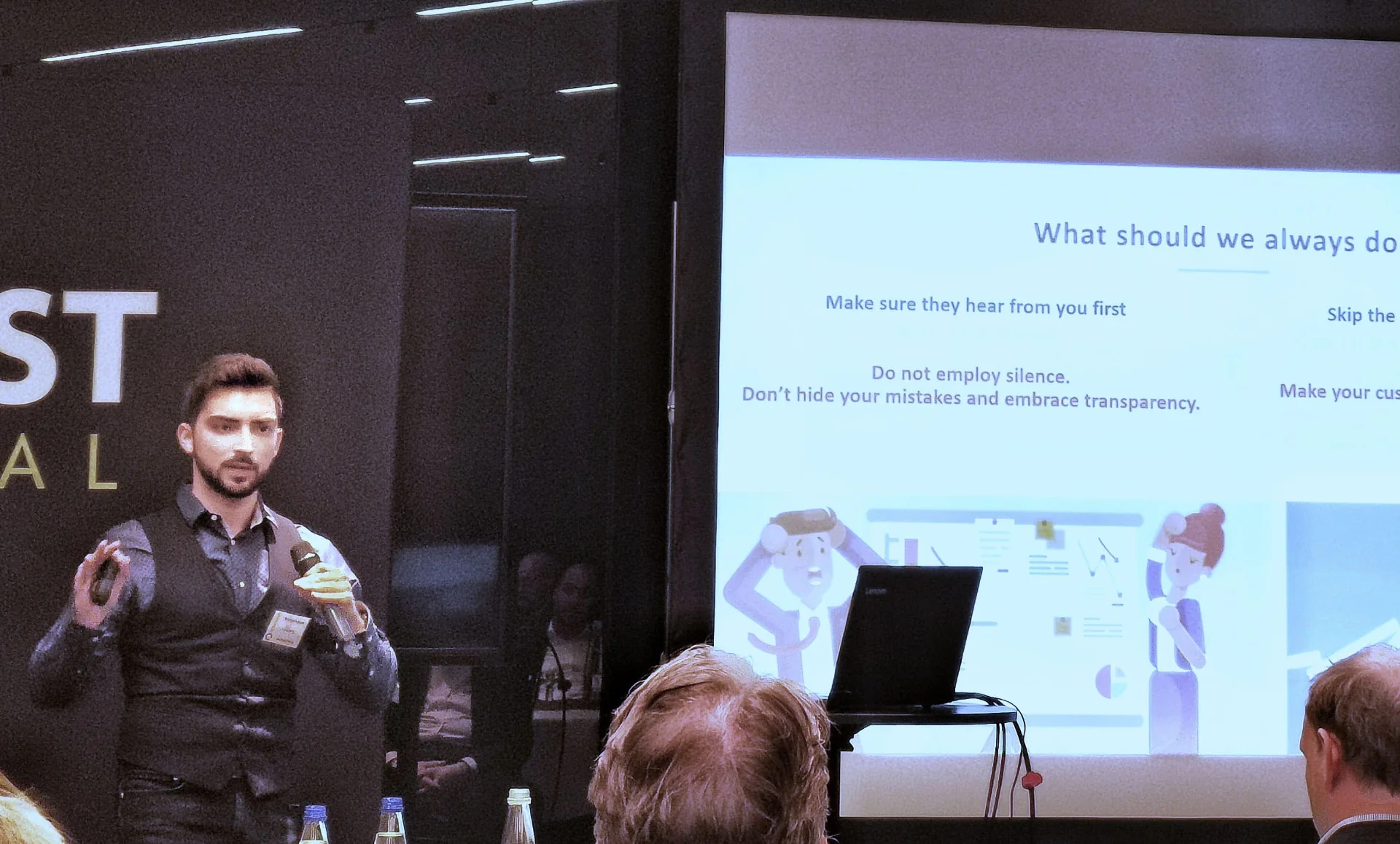
At Secfix this looks as follows:
- Every weekly all-hands starts with our current ARR on the screen, new sales and new customers.
- The monthly reports we send to investors go to all employees too, with burn rate and cash flow.
- Every Notion page and Slack channel is open, except HR topics and anything under a non-disclosure agreement.
At Skenify we still work with many hourly contractors, so by the end of the year we want to build a full-time core team with the same culture.
The question founders rarely ask investors
The question founders should ask investors, and rarely do, is how the investor can open doors for them. Founders usually just want the deal done, so they do not ask whether it is smart money that will help with new markets, hiring, sales and channel partners.
Where this first appeared
PodcastScale SEE Podcast2 Jun 2026
Watch the Scale SEE Podcast episodeWrite-updzakula.com2 Jun 2026
Read the full conversation on dzakula.com
See what your company has left exposed.
Request a trial