
Platform overview
One pipelinefrom exposure to evidence.
Skenify discovers what you expose, tests it, scores the risk, links it to the controls it affects and writes the task. This page walks through every module in the order the platform runs them.
You
You connect once. Skenify discovers, tests and assesses around the clock. You act on the task list.
Two connections today.More on the way.
Connect Google Workspace or Microsoft 365 and discovery extends from your public footprint to your accounts, your vendors and every domain verified in the tenant.
Google Workspace
Sign in as a super administrator. Reads every user's third-party app grants, the account list and verified domains.
Microsoft 365
Entra ID accounts, OAuth grants and verified tenant domains.
AWS, Azure, Google Cloud
RoadmapCloud resources and their exposure, mapped into the same inventory.
GitHub, GitLab, Bitbucket
RoadmapRepositories and dependency manifests, in the same pipeline.
Integrations
- Connected
Google Workspace
Accounts, app grants, verified domains
- Connected
Microsoft 365
Entra ID accounts, OAuth grants, verified domains
- AWSRoadmap
- AzureRoadmap
- Google CloudRoadmap
- GitHubRoadmap
- GitLabRoadmap
- BitbucketRoadmap
Everything you expose,found from one domain and one tenant.
Your domain gives the outside view. Your Google Workspace or Microsoft 365 tenant gives the inside view. Both are read continuously.
Assets
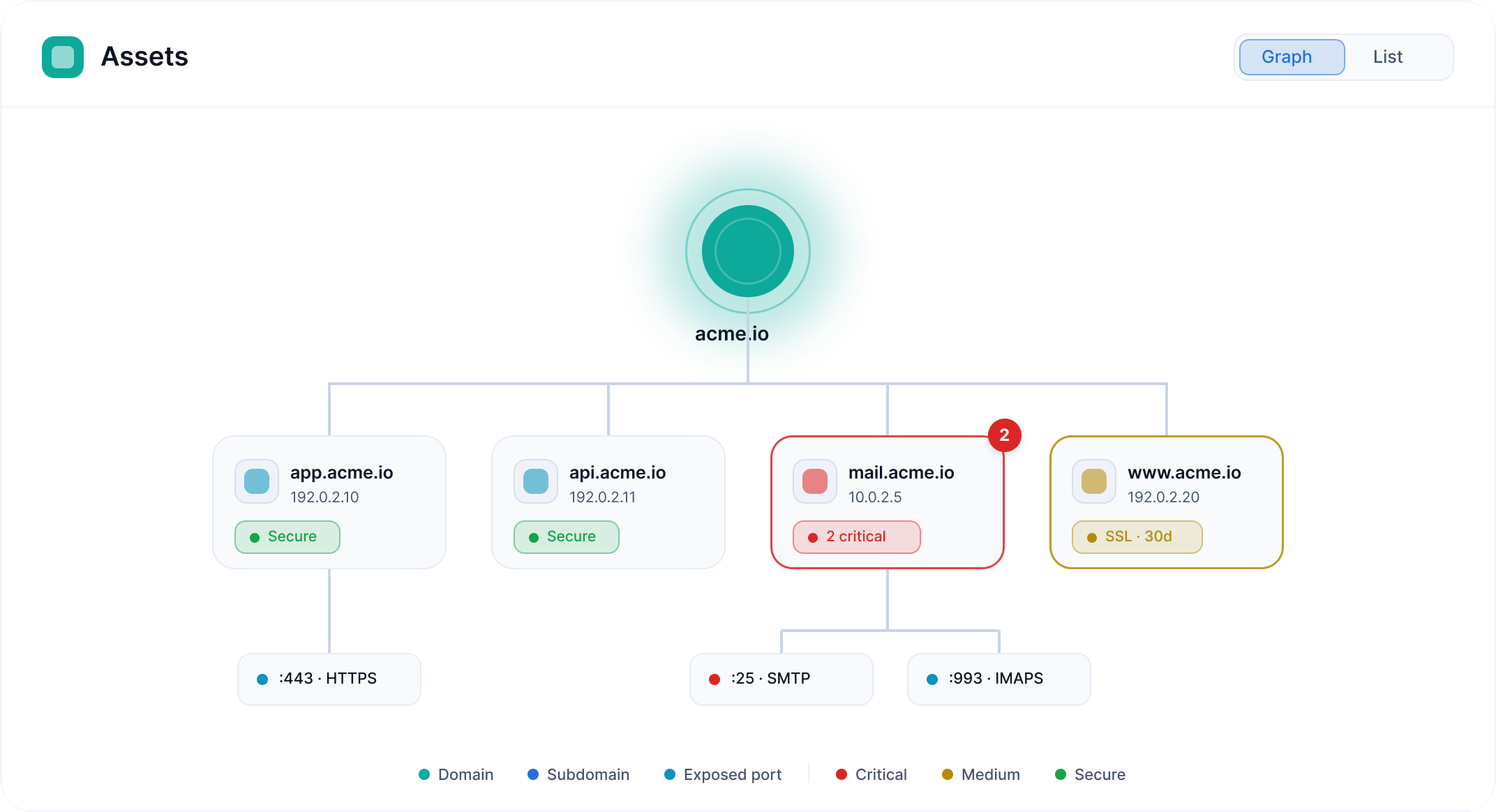
Domains, subdomains, hosts, open ports with service and product, hosting and CDN provider, TLS versions and ciphers, DNS records, blocklist listings, certificate issuer and expiry, and the IP history of every asset. List view and an interactive graph.
Vendors
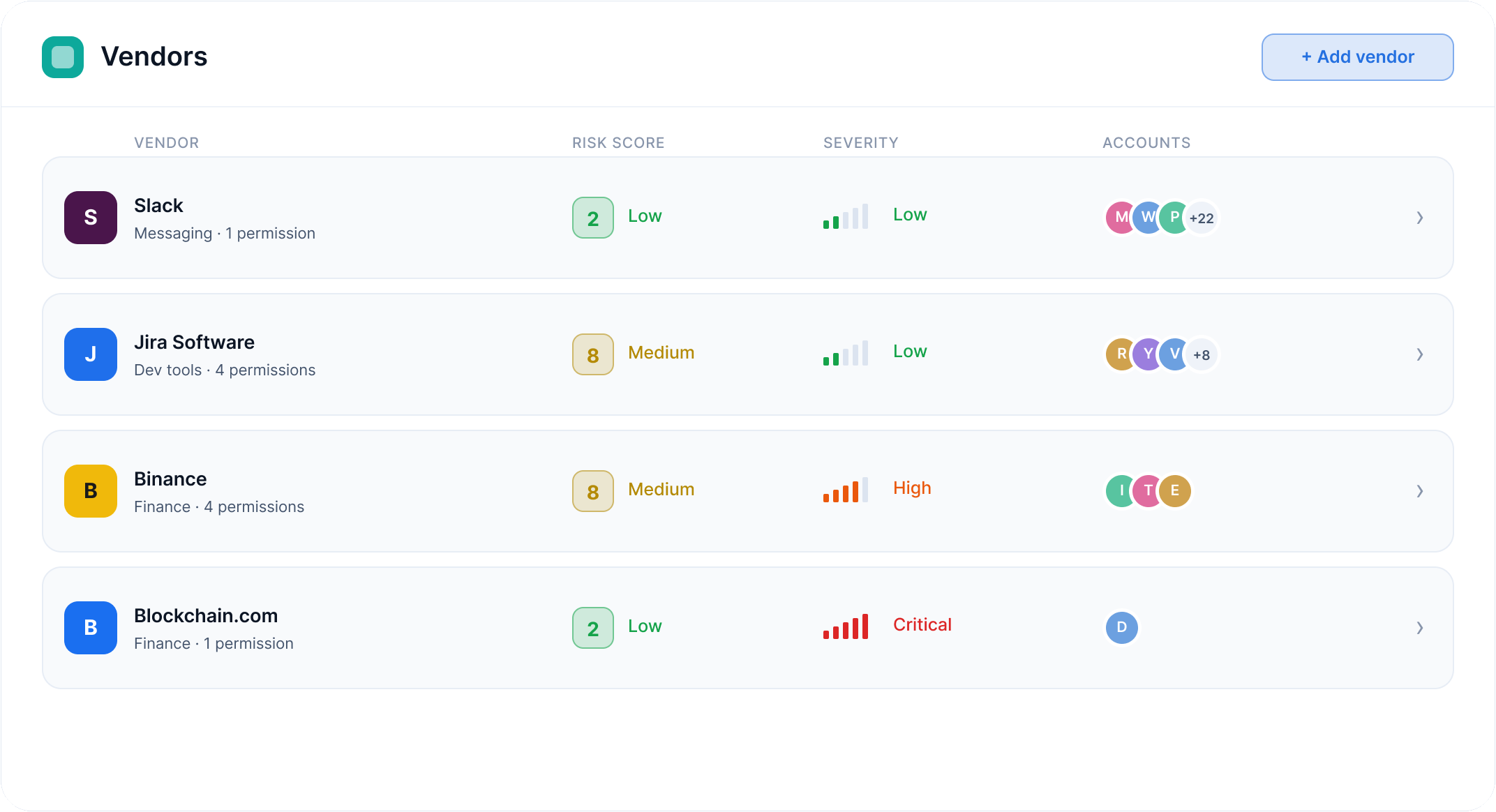
Every third-party app your people authorised, with each permission it holds, its own risk level, scope and category, and whether the grant covers one person or the whole tenant. Scored 1 to 10 with a one-sentence reason.
Accounts
Every user account in the tenant and the apps each person connected.
Monitoring scope
Domains are always monitored. You choose which subdomains to include, within your plan's asset limit.
Known exposures,flagged before someone uses them.
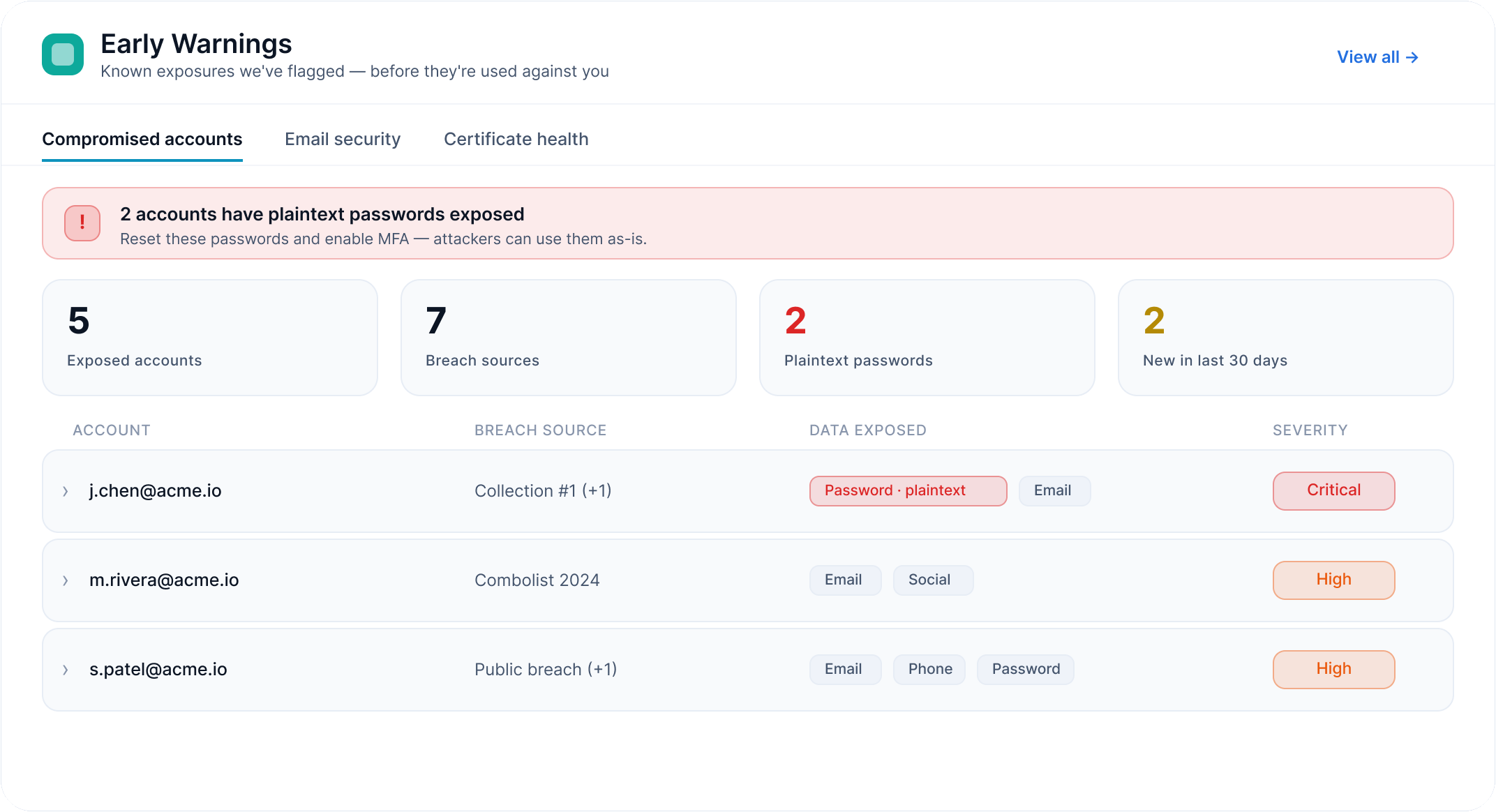
Early warnings sit in three tabs and each one ends in a sentence a non-specialist can act on.
Compromised accounts
Employee credentials matched against known breaches, with the source, the data exposed, whether the password was in plaintext and whether the account is still active.
Email security
SPF, DKIM and DMARC per domain with one verdict: a forged email would be delivered, or blocked.
Certificate health
Expired, expiring within 7 days, expiring within 30 days, and TLS issues, per asset.
The checks that fit each asset,and nothing you cannot act on.
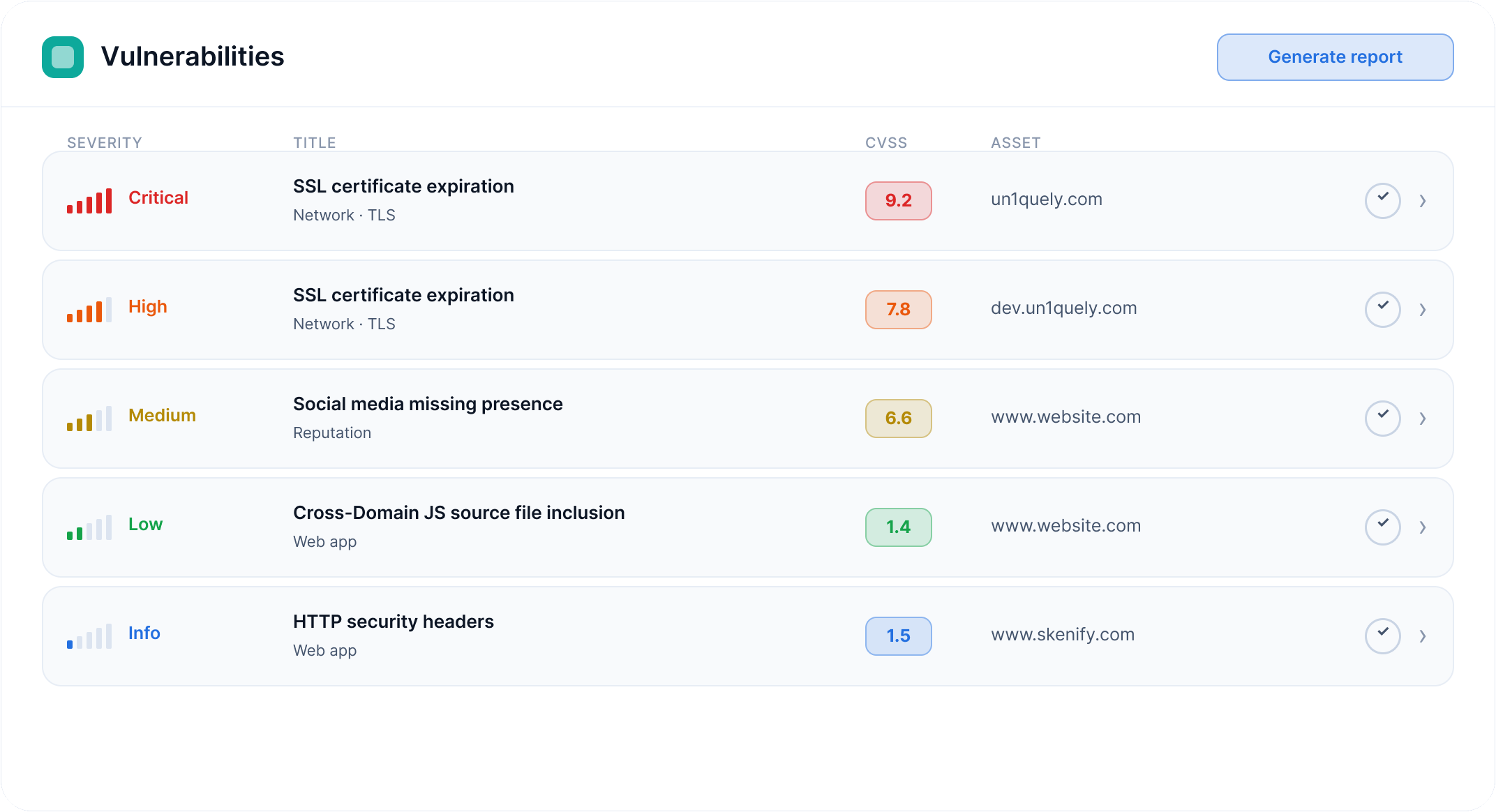
Every finding is proven on the live asset before you see it, de-duplicated, scored with CVSS v3.1 and written up with its impact and the fix. The result is zero false positives. Find one and your next month is free.
DNS
CAA, DNSSEC and PTR records.
SPF, DKIM key length, DMARC enforcement, MTA-STS.
Web hosts
HTTP security headers and CORS on every host.
Brand
Lookalike and typosquatting domains, including those able to send mail. Subdomain takeover.
Network
Scanning of the hosts behind your assets for exposed services. Hosts behind a CDN are tested at the web layer.
Web applications
Passive scans in production or active scans in staging, as a logged-in user if you give the scanner a test account.
Occurrences
The same issue on ten hosts is one finding with ten occurrences, each with its own status.
Why verification comes first
The most common finding is rarely the dangerous one. Security misconfiguration is the largest class our team sees in penetration tests, and about 1% of it is Critical or High.
Two out of three broken access control findings are Critical or High, and they make up 30% of all serious findings. A scanner can flag that an issue is possible. In Skenify, AI agents attempt the exploit and senior penetration testers confirm it before it reaches your task list.
From our team's penetration testing work through The Security Company, 2021 to November 2026. Anonymised.
See the dataFindings become risksa board can read.
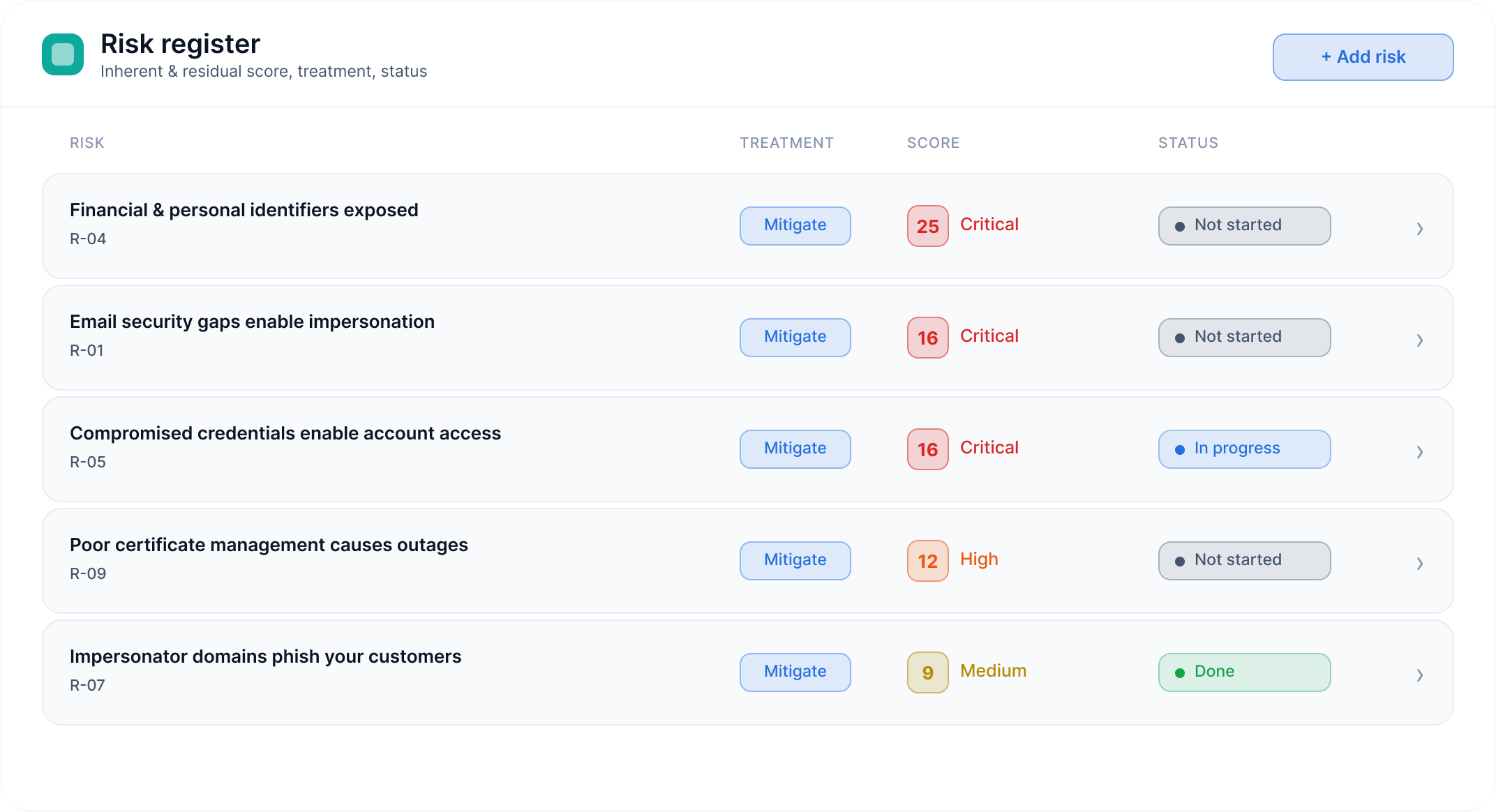
Each proven finding is written up as a business scenario and scored for your business on a 5 by 5 likelihood and impact matrix, before and after treatment. It gets a strategy, an owner and a status.
Business context
AI builds a context for your company from the public web and from your connected environment, and keeps it current. The context decides how each risk is scored and what the task says.
Scoring
Likelihood 1 to 5 by impact 1 to 5. Informational 1 to 2, Low 3 to 6, Medium 7 to 10, High 11 to 15, Critical 16 to 25.
Treatment
Mitigate, accept, avoid or transfer, with the plan written down and a residual score.
Library
About 126 ready scenarios for the risks scans cannot see, so the register can hold the whole picture.
Links
Each risk shows the findings that feed it, the tasks that treat it and the assets it touches.
ISO 27001 evidence,generated as you work.
Every risk is linked to the ISO/IEC 27001:2022 controls and clauses it affects. The compliance view counts the controls your findings reach, grades each as addressed, needs attention or open, and names the controls to improve next in order of residual risk.
Controls
14 of 93 Annex A controls touched on a typical first scan, each with its state and the risk behind it.
Clauses
Findings counted against management-system clauses 4 to 10.
Scope stated
People (A.6) and physical (A.7) controls are marked not assessed, because the scans do not observe them.
Reports
A posture report and a compliance impact report, both PDF, with a reference and a timestamp.
of 93 controls touched
Addressed 6, Needs attention 3, Open 5
A task boardthat writes itself.
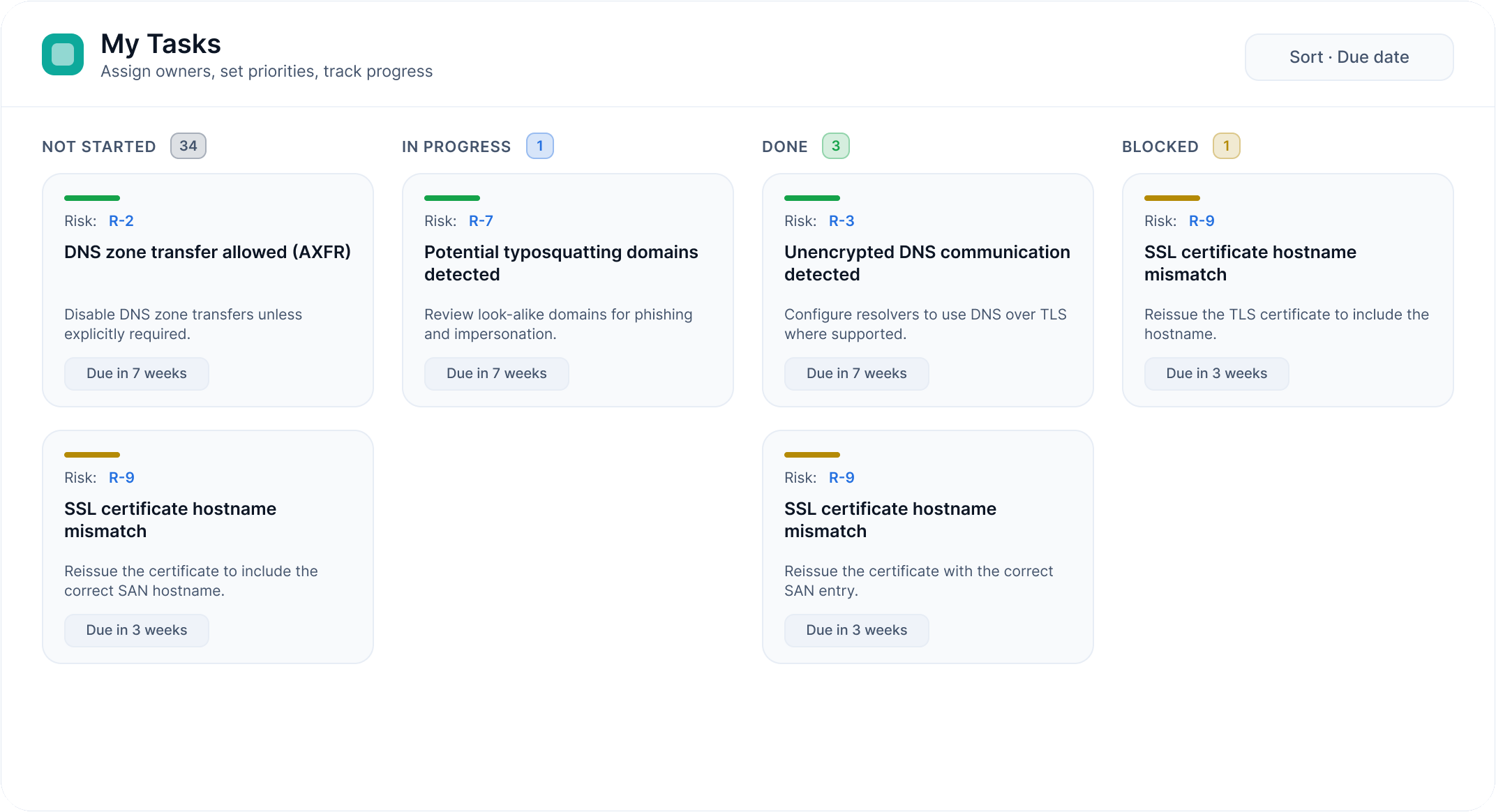
One task per finding with the exact change to make, a due date from the severity SLA and a priority. Your team assigns owners and works the board.
SLA
Critical 7 days, high 30, medium 90, low 180. The due date is set when the finding appears.
The fix
The task carries the record to publish, the header to set or the policy to change, not a link to a knowledge base.
Progress
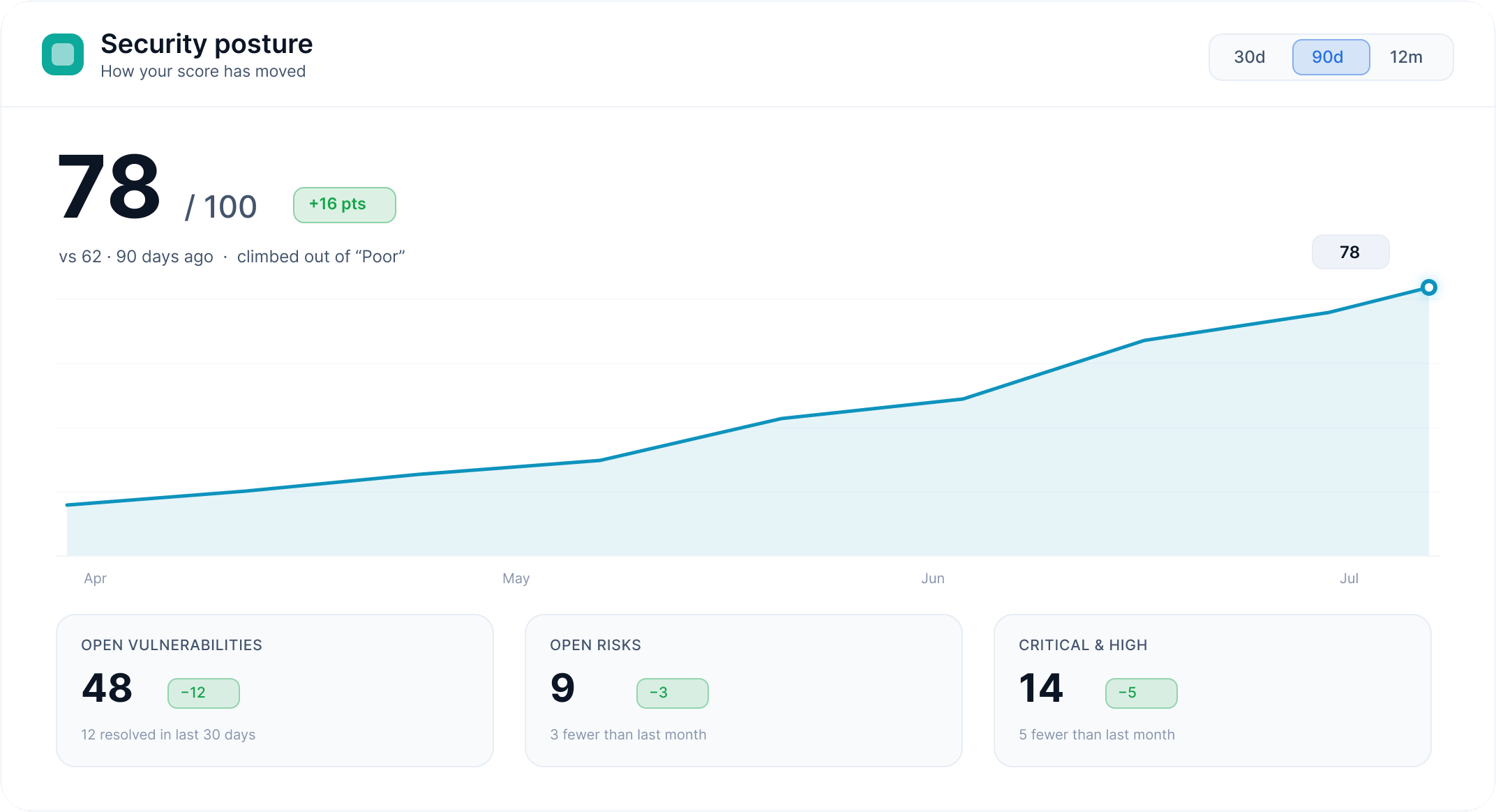
Mean time to remediate, findings past SLA and backlog age on the posture page, with a score that moves as tasks close.
Expert pentesting,ordered from inside the platform.
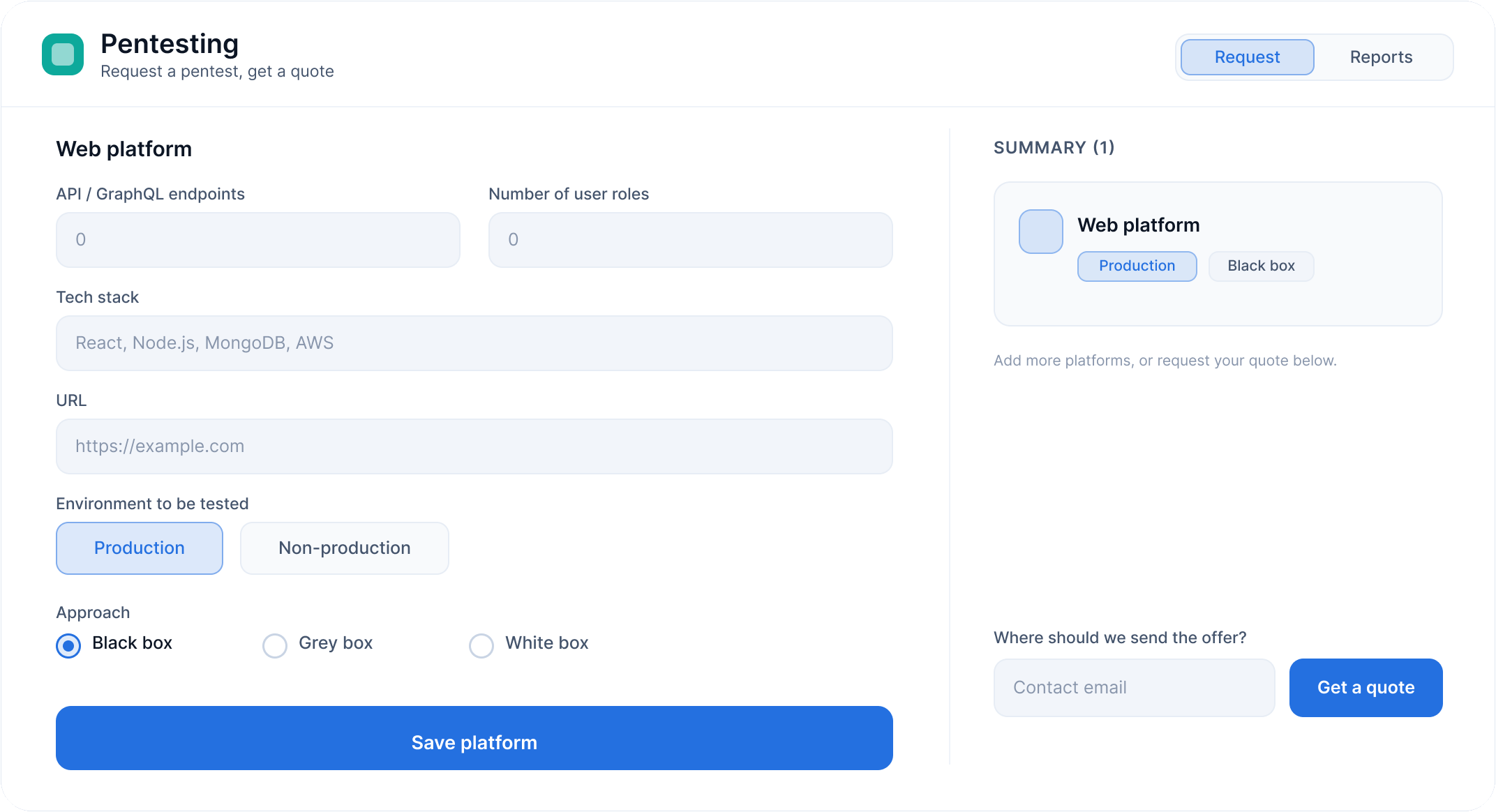
Scope a web, mobile or network test, choose black, grey or white box, receive a quote, accept it, and get the report where your tasks already live. Paid customers get 20 percent off every test.
Next release: AI pentesting. Automated tests whose findings land in the same vulnerability list, register and board.
One finding in seven is Critical or High. The other six still land on your list, and someone has to tell them apart.
- engagements delivered
- 376
- organisations tested
- 278
- findings documented
- 2,650
- Critical and High findings
- 406
From our team's penetration testing work through The Security Company, 2021 to November 2026. Anonymised.
See the dataBuilt to be runby a team of one.
Sign in with Google or Microsoft; no local passwords.
Owner, Editor and Viewer roles; unlimited members on the paid plan.
Support cases from inside the platform, answered by the team that builds it.
Data stored in Frankfurt, EU. ISO 27001 and ISO 42001 certified.
See your own numbersthis week.
Seven days, no card. We approve requests within 24 hours and findings land about fifteen minutes after you connect.