
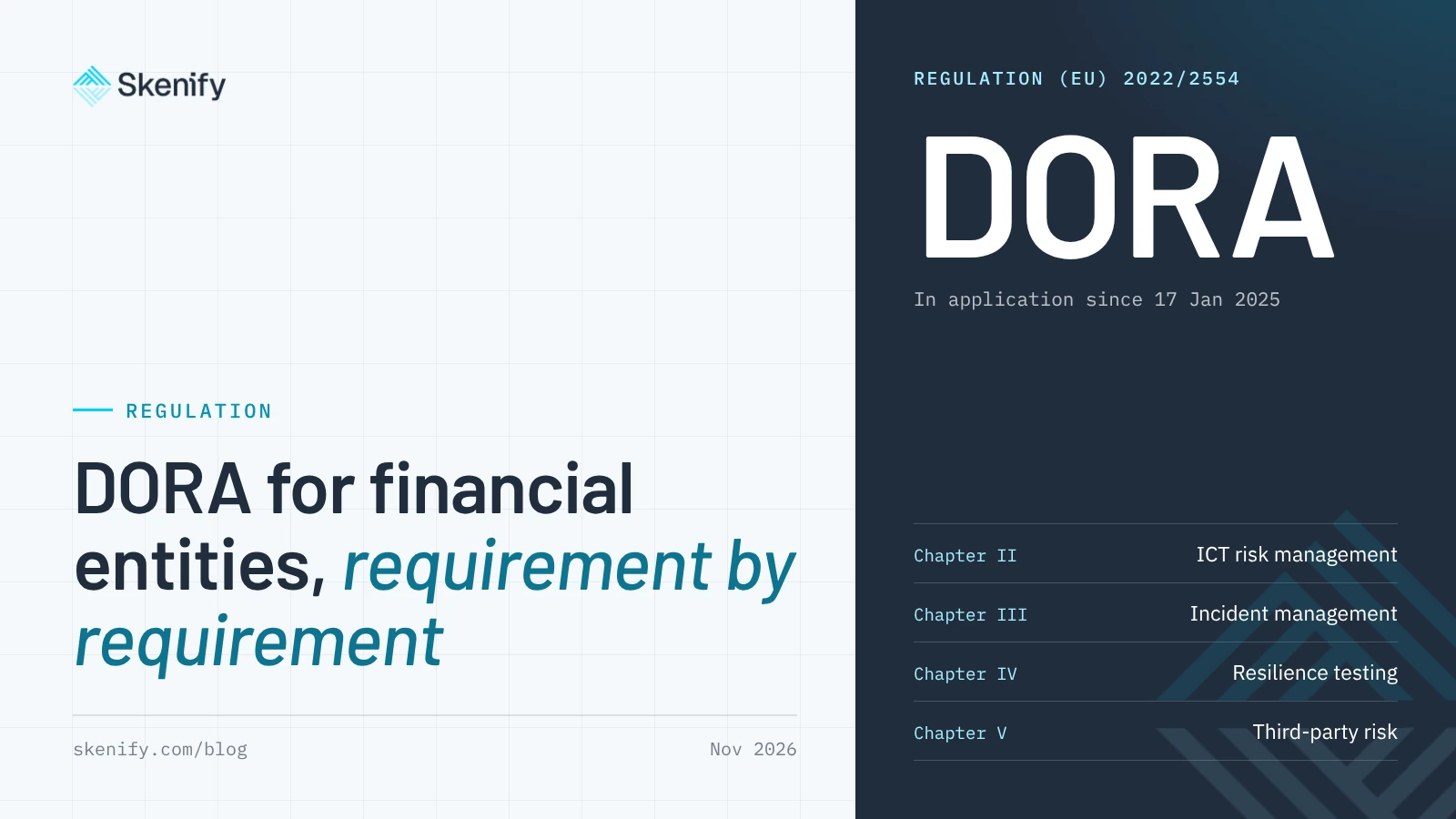
The Digital Operational Resilience Act sets uniform rules for ICT risk in the EU financial sector. It has applied since 17 January 2025 to banks, investment firms, insurers, payment institutions, crypto-asset service providers and fund managers. ICT providers that serve them feel it through contracts, because financial entities must manage third-party risk through the whole lifecycle.
What each chapter asks for, and what Skenify produces
- Chapter II, ICT risk management. Skenify keeps a risk register with inherent and residual scoring, owners and treatment strategies, and a task board with SLA-based due dates as evidence of follow-through. Governance and accountability are yours.
- Chapter II, asset identification. Internet-facing domains, hosts, ports and certificates are listed and drawn as a graph that changes with your footprint. Internal inventories and criticality classification are yours.
- Chapter II, protection and detection. Continuous vulnerability scanning with CVSS, TLS and header checks, breached-credential monitoring and early warnings for spoofable domains and expiring certificates. Patching, encryption and internal monitoring are yours.
- Chapter III, incident management. Exposure alerts and the register serve as incident evidence. Classification and reporting to the competent authority are yours.
- Chapter IV, resilience testing. Expert web, mobile and network penetration tests are scoped and ordered in the platform, with reports as evidence. Threat-led penetration testing is yours.
- Chapter V, third-party risk. Third-party apps are discovered from OAuth grants in Google Workspace and Microsoft 365, each with its permissions, risk score and account reach. The contractual register is yours.
The part most teams underestimate
Most teams have a list of the ICT providers they pay. Far fewer have a list of the applications their employees connected to company accounts with one click. Each of those grants can read mail, files or calendars, and each is a third party under DORA. Skenify builds that inventory from the tenant itself.
Where to start this week
- Take the free DORA gap assessment. It takes about five minutes and the gap report arrives by email.
- Use the 46-practice security checklist, mapped to NIS2 and DORA, as a working list for your team.
- Request a trial on your own domain to see your external footprint and connected third parties.
Sources
Legal textEUR-Lex14 Dec 2022
Regulation (EU) 2022/2554 (DORA)
On Skenify
Check your alignment with DORA in five minutes. Your score is shown at once.
Take the free DORA gap assessment