
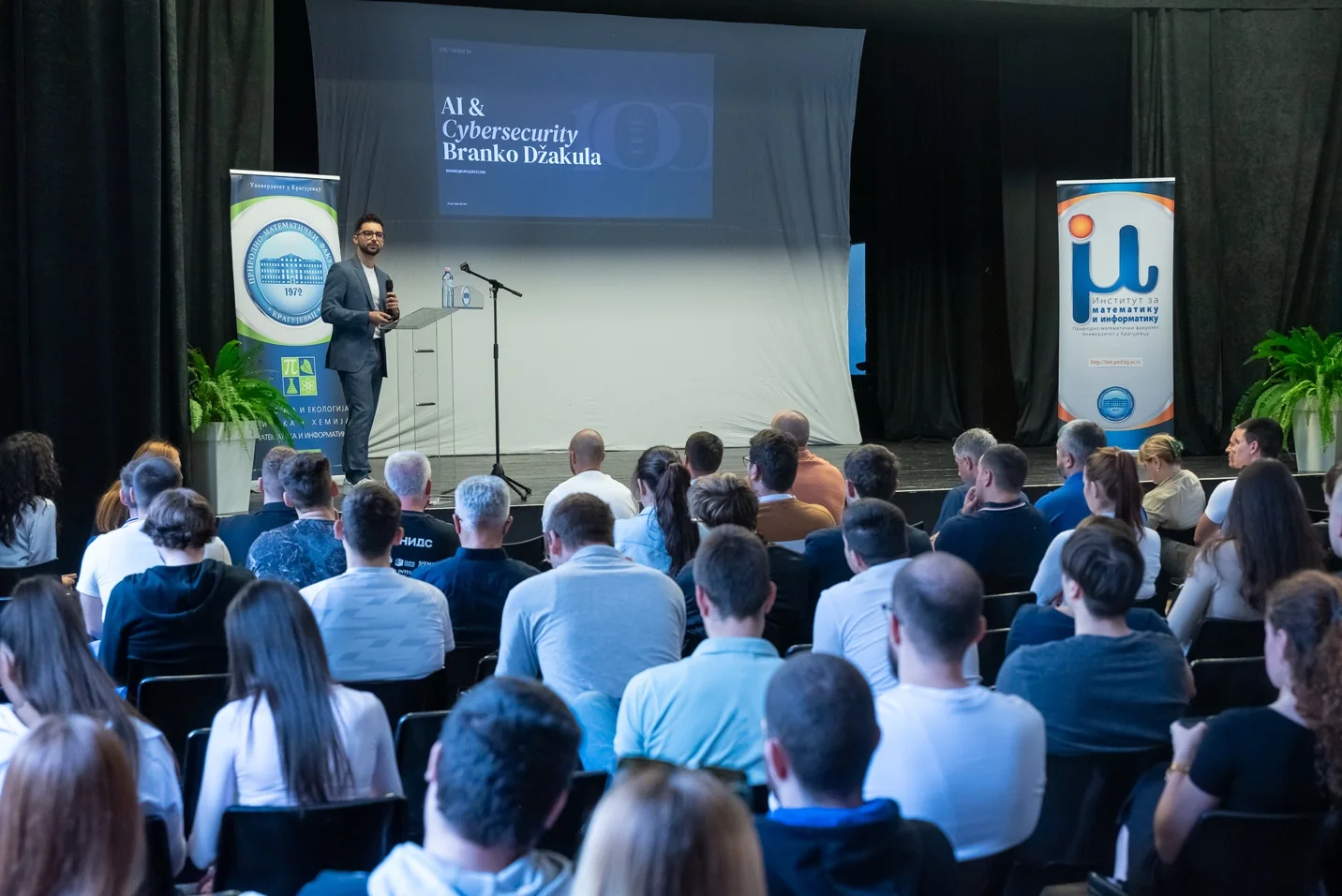
In an interview for Standard I said that people in Montenegro are unprepared for the AI era. A month later, in the studio of Radio Antena M, we talked about how vulnerable society is in the age of algorithms. This post brings the two conversations together for a company owner or an IT manager.
Using AI and understanding AI are two different things
Montenegro has roughly 472,000 active social media users, and most of them touch AI every day through chatbots and recommendation algorithms. Public attitudes sit at two extremes. Some people treat AI as an oracle that always tells the truth. Others treat it as a threat from a science fiction film. Both come from the same lack of basic digital and AI literacy, and both lead to business, health and parenting decisions built on tools people cannot evaluate.
With free services, you are the product
Many of our decisions are now directed by algorithms, because we allowed it. Our personal data is used to tune them. For harmless fun, such as a digital avatar made from a photo, we hand over very sensitive data. The platforms get to know us better than the people closest to us, which is why it can feel as if the phone is listening when it shows a particular advertisement.
The same habit follows people to work.
The risk inside your company
For companies the sharpest risk is Shadow AI. Employees paste contracts, financial reports or source code into public chatbots to get work done faster. Research finds that 77% of staff in large companies do this. Samsung banned ChatGPT internally after source code was entered into it. Incidents that involve Shadow AI cost on average 670,000 USD more than ordinary breaches.
The attacks have changed too
- Voice cloning needs about three seconds of audio. An Arup employee lost 25.5 million USD in a video call where every other participant was synthetic.
- About 82% of phishing email is now generated with AI. Clumsy grammar used to be the easiest sign of a scam, and that sign is gone.
- Deepfakes are local. In 2025 fraudsters altered an interview with a well-known Montenegrin doctor to advertise a dubious medical product on a site built to imitate a local television portal. The likeness of the prime minister and several members of parliament has been used for fake statements about wages, pensions and cryptocurrency.
- Trust itself is damaged. By early 2026 the public argued over whether videos of a fugitive were real at all, and forensic analysis often can no longer settle such a question.
What your company can do this month
- Write an acceptable-use policy for AI tools, in one page.
- Keep a register of approved tools, so people know what they may use.
- Train your people on Shadow AI with examples from their own department.
- Keep a human in the loop on every critical decision.
- Use recognised standards such as NIST AI RMF and ISO/IEC 42001 as your reference.
What every employee can do today
- Agree a family code word against calls with a cloned voice.
- Verify through a second, known channel whenever a request is urgent.
- Keep personal, medical and confidential data out of free AI tools.
- Open the privacy settings of the AI tools you use. ChatGPT, for example, has an option that stops your conversations from being used to train its models, and you can delete your history.
Critical thinking is the protection we have for now
Until regulation takes hold and the platforms help us, critical thinking is the protection an individual has. I use three steps before sharing anything.
- When a sensational story or photo makes you angry and you want to share it at once, stop for a second.
- Ask yourself whether it is real, and spend half a minute checking the sources.
- Ask an AI tool to check whether credible sources have reported the story. It does good research and answers quickly.
Do not stay away from AI
Fear is justified if you look only at the negative consequences. AI is a tool, and I advise everyone to be very curious about it and to try it in their own work, whatever that work is.
If you fear that the tasks that fill most of your working day will be automated, let the change start with you. Offer to lead the automation of that work, and put your hand up for the tasks AI cannot finish. AI has saved me so much time on documentation and email that I can be there more for my employees and my family.
The law is catching up
The EU AI Act makes AI literacy a legal obligation, and Montenegro will have to align its legislation as a candidate country. You do not need to wait for the law to start with the lists above.

Radio Antena M interview
Where this first appeared
InterviewStandard25 Apr 2026
Read the Standard interview (in Montenegrin)InterviewRadio Antena M26 May 2026
Watch the Radio Antena M interview
See what your company has left exposed.
Request a trial