
Journalist Višnja Cvetković asked me for Ekipa, the portal of the Trade Union of Media of Montenegro, how ready Montenegrin newsrooms are for fake audio and video made with artificial intelligence. My answer was that most of them have no written procedure for checking material that arrives from outside, no named person responsible for it, and no forensic contact arranged in advance who can respond within hours.
Verification often depends on the judgment of one editor and on how convincing the clip looks, and generative models increasingly beat that standard. Small teams have an advantage. People know each other, decisions are short, and colleagues recognise each other's voices and ways of speaking. That advantage only counts if a procedure exists before a suspicious recording arrives, especially when the material is attractive and there is pressure to publish first.
The method below was written for newsrooms. It works the same way for a finance team that receives a voice message from the director or a video call with a supplier.
What AI can fake today
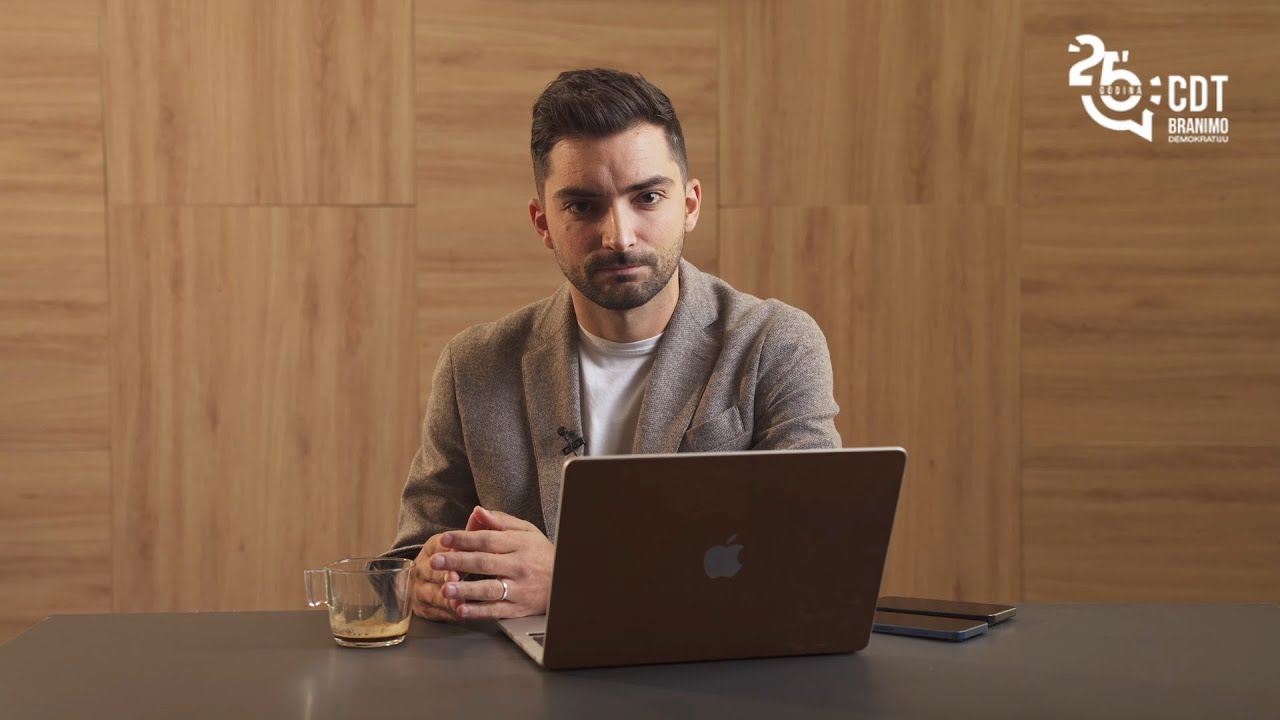
In a short video I recorded for CDT, artificial intelligence turns me into a completely different person, and the cloned voice of a friend calls to ask for money urgently after an accident. Both examples were staged, and both took little effort to make.
- Text. AI writes whole articles and even scientific papers that look authentic. It can imitate the style of well-known portals and produce fake news in huge amounts in very little time.
- Photos. It creates people who do not exist and puts real people in situations they were never in. The image of Pope Francis in a large white jacket went around the world, and many people believed it.
- Video. We have seen fake videos of world leaders, including the Ukrainian president. They were exposed quickly, but their aim was to cause chaos and distrust.
- Voice. A few seconds of a voice are enough to clone it. A voice message from a family member asking for money may not come from them at all.
Deepfake: kada lice i glas postanu oružje
Why this matters to an organisation
- A fake advertisement for an investment platform used the likeness of a news presenter to borrow the trust of the audience.
- In Slovakia, a fake audio recording was published in September 2023, two days before the election and during the pre-election silence, which made a timely denial harder.
- Research since 2019 consistently shows that most deepfake material online is non-consensual sexual content, and the vast majority of it targets women.
- Authentic recordings can now be dismissed as fakes, which is a second kind of damage.
Verification in three levels
- Origin of the material. Establish where the file came from and who sent it first, before you look at the content.
- Independent confirmation. Reach the person whose face or voice is used through a channel you set up in advance. Compare the material with your archive, down to details such as graphics, the set and the clock in the studio. For urgent communication, agree a control word or a question only the real person can answer.
- Technical analysis. Look at the edges of the jaw and hair, the rhythm of blinking, lips that do not match the voice, room acoustics and breathing. Automatic detectors lose reliability after repeated compression and re-encoding, so treat their result as an indication only.
Decide in advance who checks the source and the original file, how you get independent confirmation and who makes the final decision. Do not rely on any single AI detector, and do not publish or act on anything without a second, independent confirmation.
Protect your own recordings
- Keep original files and timestamps of everything you publish.
- Use Content Credentials, the C2PA standard, where you can.
- Maintain a public archive of your broadcasts or official videos, so anyone can compare.
A response plan for the day a fake appears
- Prepare the text of a denial in advance and aim to react within one hour.
- Name one spokesperson.
- Prepare takedown reports for the platforms before you need them.
- Contact the national CIRT and the police, and collect links, screenshots, timestamps and file hashes at once.
- Run at least two practical trainings a year, including a simulated incident with a fake made from your own material.
An attack on the face or voice of one of your people is an attack on the organisation, and you should treat it that way.
For everyone else: stop and check before you share
Before you share something, check the source and see whether several reliable media have published it. Local fact-checking portals such as Raskrinkavanje analyse this kind of manipulation every day. Look for details that do not fit in photos and videos, and be sceptical of anything that sounds too shocking to be true.
Where this first appeared
ArticleEkipa10 Nov 2026
Read the Ekipa article (in Montenegrin)VideoCDT Crna Gora26 Dec 2025
Watch the CDT video on deepfakes
See what your company has left exposed.
Request a trial