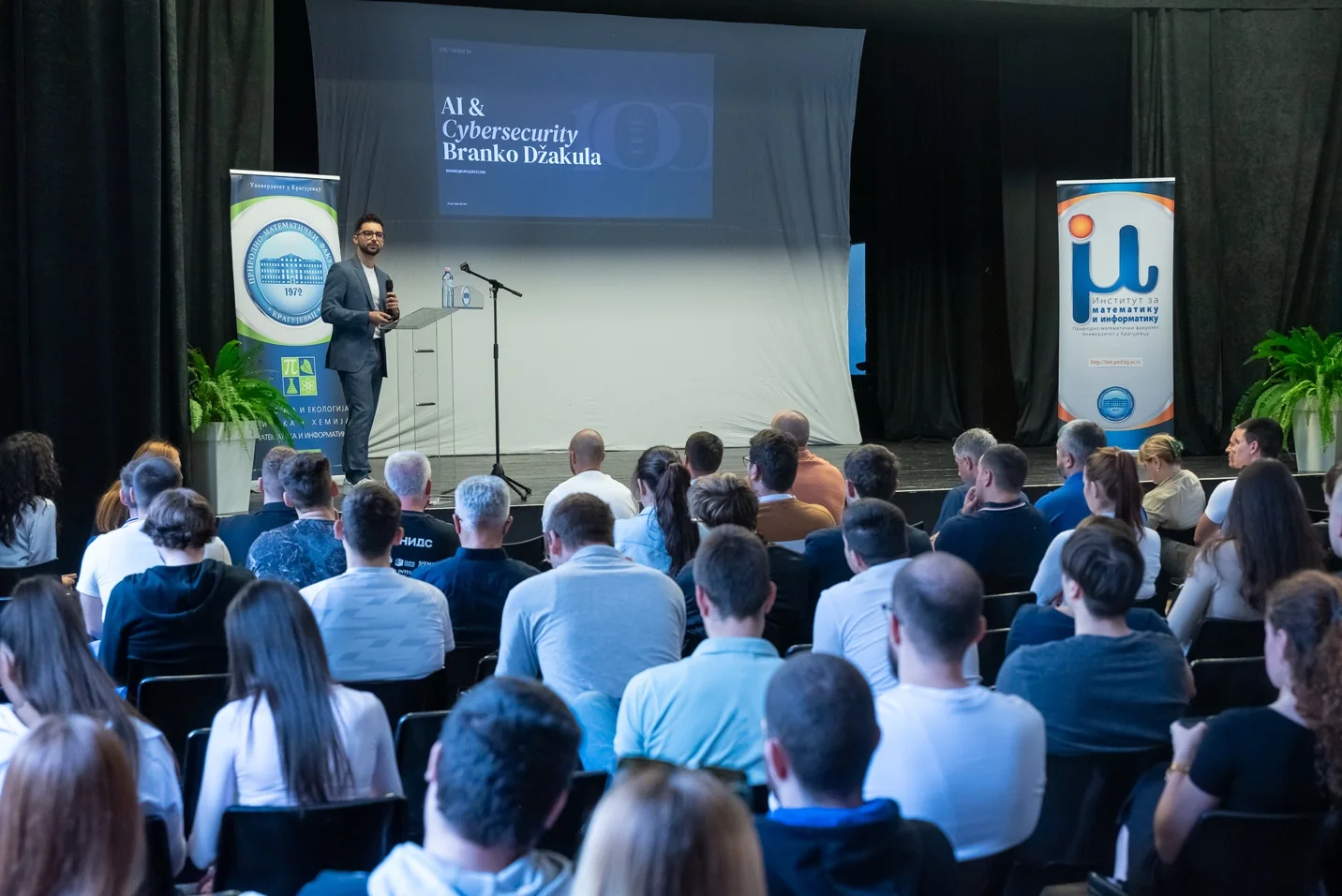

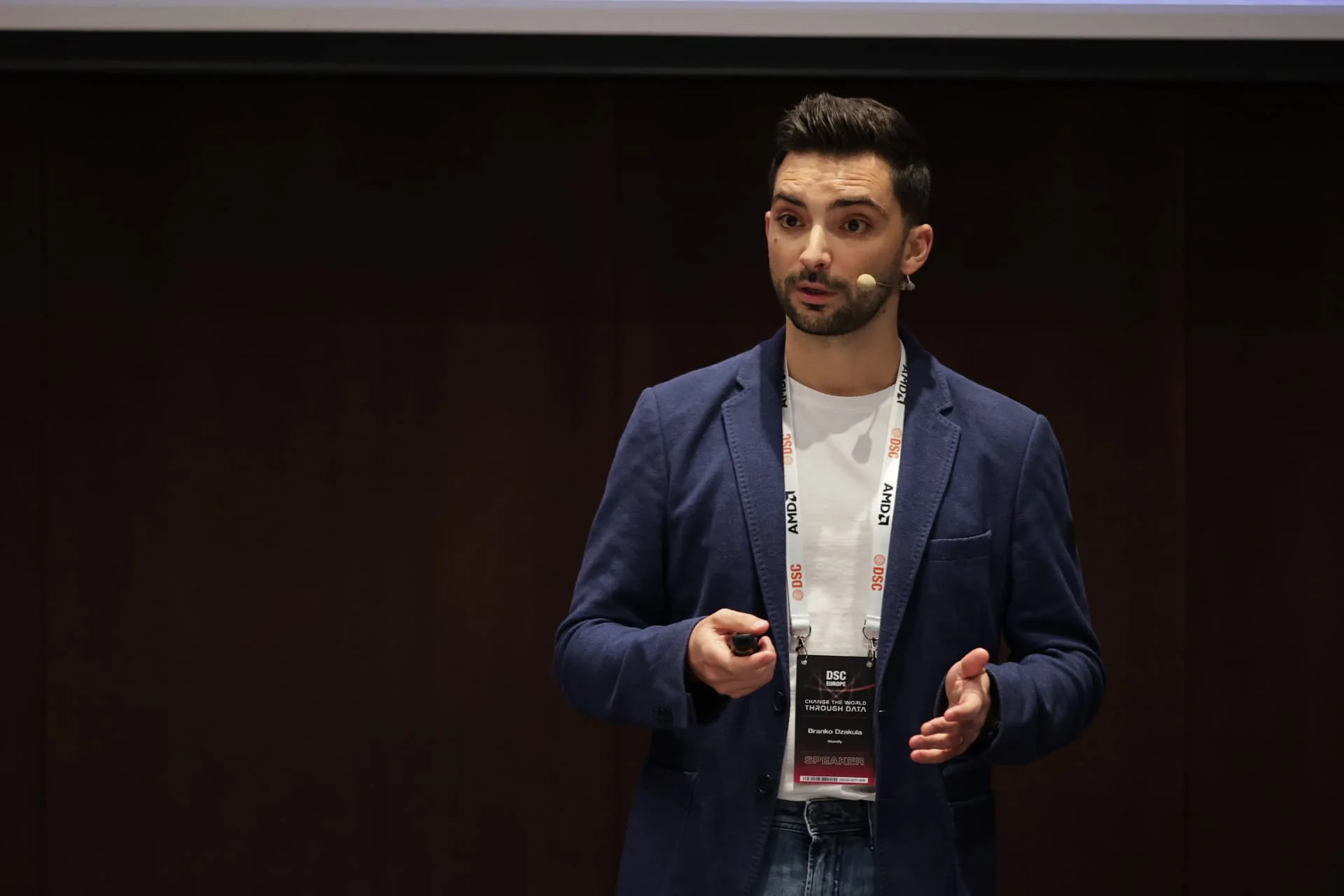
At DSC Europe 25 in the Sava Centar in Belgrade I gave the closing talk of the fourth day, in the track on AI in cybersecurity. The announced topic was how AI redefines cyber threats. I approached it as an entrepreneur: how generative AI is used against companies and ordinary people, which security tools you can build yourself, and which problems are still waiting for a startup.
AI is a tool, and it matters who is behind the wheel
The cybersecurity industry exists because some people have bad intentions. Anything you can generate, you can also generate for a malicious purpose. In practice that means social engineering. Attackers produce phishing emails tailored to one person, deepfake videos that get more realistic with every new model, and cloned voices.
These attacks now target the general public more than large enterprises. I have received many text messages from a fake postal service asking for my card details. On the morning of the talk, an email reached my HR with the full name of one of my employees. It asked, in Serbian Cyrillic, for his salary to be paid to a new bank account. AI makes attacks like this easier and faster.
Your own security tools in a few prompts
Export your logs from Microsoft Intune or Microsoft Defender and ask a current AI model to correlate them and point out anomalies, errors and critical issues. It works like a simple SIEM, and it takes a few minutes to build. With a tool such as Lovable you can turn it into a web application connected to your systems through APIs.
The security industry presents new AI tools every month, and many are the same tools with AI agents built in. I sell security tools myself, so I should not say this, but you probably do not need all of them. A very small company can build a useful set of its own.
Detecting deepfakes
A tool that detects a deepfake with full certainty would be worth a great deal. A year before the talk, hands in AI videos still had six or seven fingers. When I generated ordinary scenes from real photos with the latest video models, about half the time I could not tell that anything was wrong. Tools that recognise AI content and keep it from being pushed higher in our feeds are a large opportunity.
Penetration testing has to become continuous
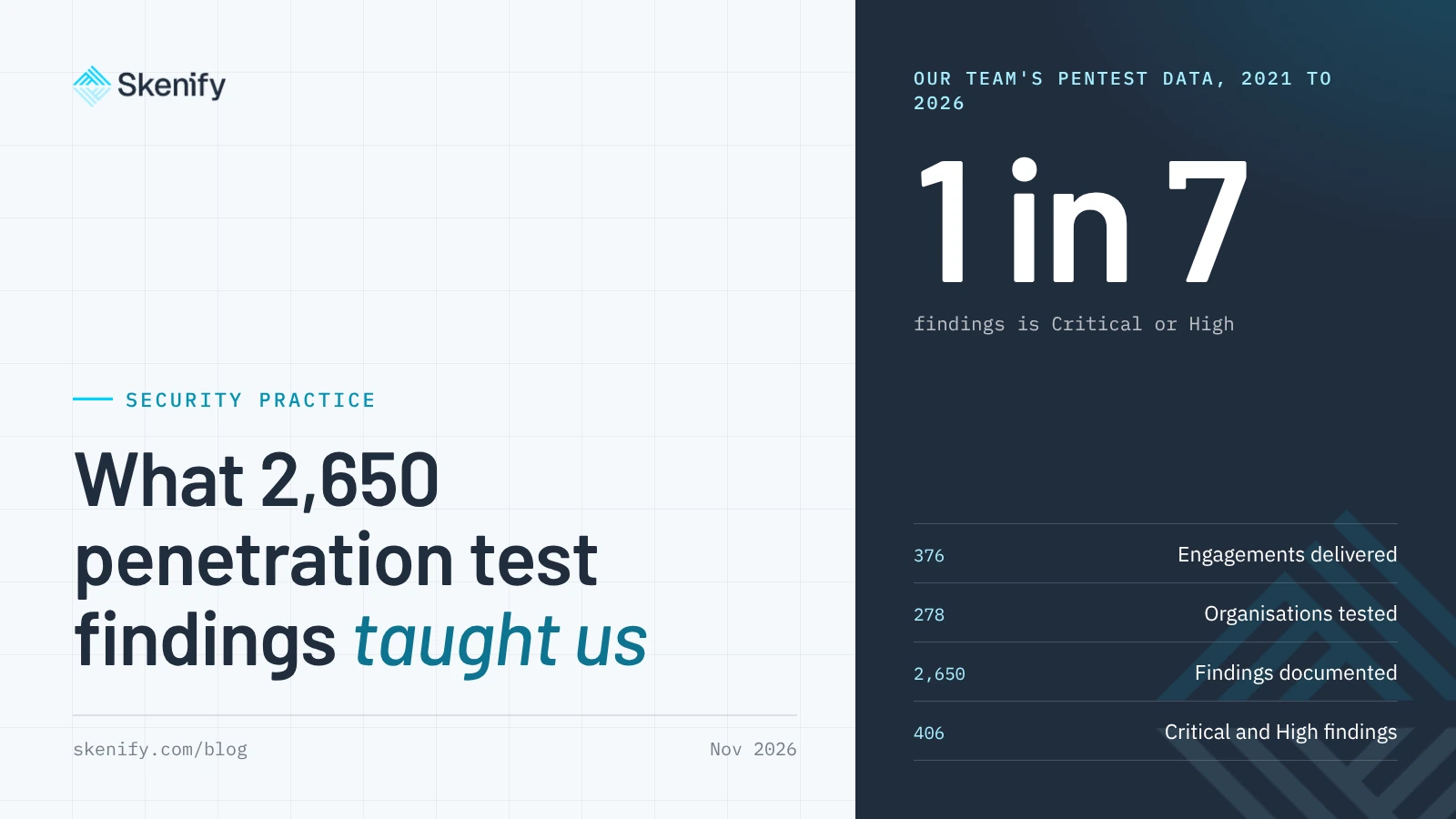
Penetration testing is a great process, but it is manual, expensive and shows a single point in time. I know this because we sell it. Two people need at least 5 to 10 days to test a system, and every new feature means testing again.
Testing should be automated and continuous. A system keeps trying to break in and reports what it finds, from a back door to administrative privileges gained with a basic user account. Penetration testers then verify the findings in about 20% of the time they spend today.
This is the direction we follow at Skenify. AI agents attempt to exploit each finding and senior penetration testers confirm it before it reaches your list.

From Defense to Attack: How AI Redefines Cyber Threats
Compliance and quantum-safe encryption
Serbia adopted a new information security law with many new requirements, and most companies do not know where to start. Compliance is mostly project management. I told the audience that someone could sit down that evening, load the law into an AI builder and have a working project tool for implementing it by two in the morning.
Quantum-safe encryption has been a topic for two or three years. Attackers will one day use quantum computers to break current encryption. The financial sector will be the first target, because attackers go where the money is, and regulatory requirements in the European Union are already moving it to quantum-safe methods.
The minimum for every company
Someone in the audience asked about lateral movement during an attack. In a company without any security solutions, an attacker who owns an administrative account has practically won. AI can correlate logs faster than any analyst and stop an attack before a human notices. SIEM tools and modern malware protection are the bare minimum.
AI beyond security
We talk about threats, risks and attacks all day in this profession, so I asked the audience to follow the good news as well.
- Healthcare. With AI, work on proteins and medicines tailored to each person that would have taken a century may take a decade.
- Education. AI tutors can quiz a child on any subject, in any language, until the child masters it, without handing over the answers.
- The environment. AI with sensors around the world could show where soil, air or water is at risk before it is too late.
Digital violence among children
Teenagers are bullied online, recorded and targeted with AI deepfakes made to mock them, and they feel shame even when the video is not real. Many of us can use the same tools to make children safer. That is one reason I see cybersecurity as a good calling. You protect companies, and you can also help protect children.
Stay curious, creative and ethical
How you apply AI is up to you. Creativity has to stay human. When you ask an AI model for ten ideas, two or three will be good and the rest will not, and you are the one who recognises which are which. Stay curious, and stay ethical.
Where this first appeared
TalkDSC Europe 2520 Nov 2025
Watch the talkWrite-updzakula.com20 Nov 2025
Read the full write-up on dzakula.com
See what your company has left exposed.
Request a trial