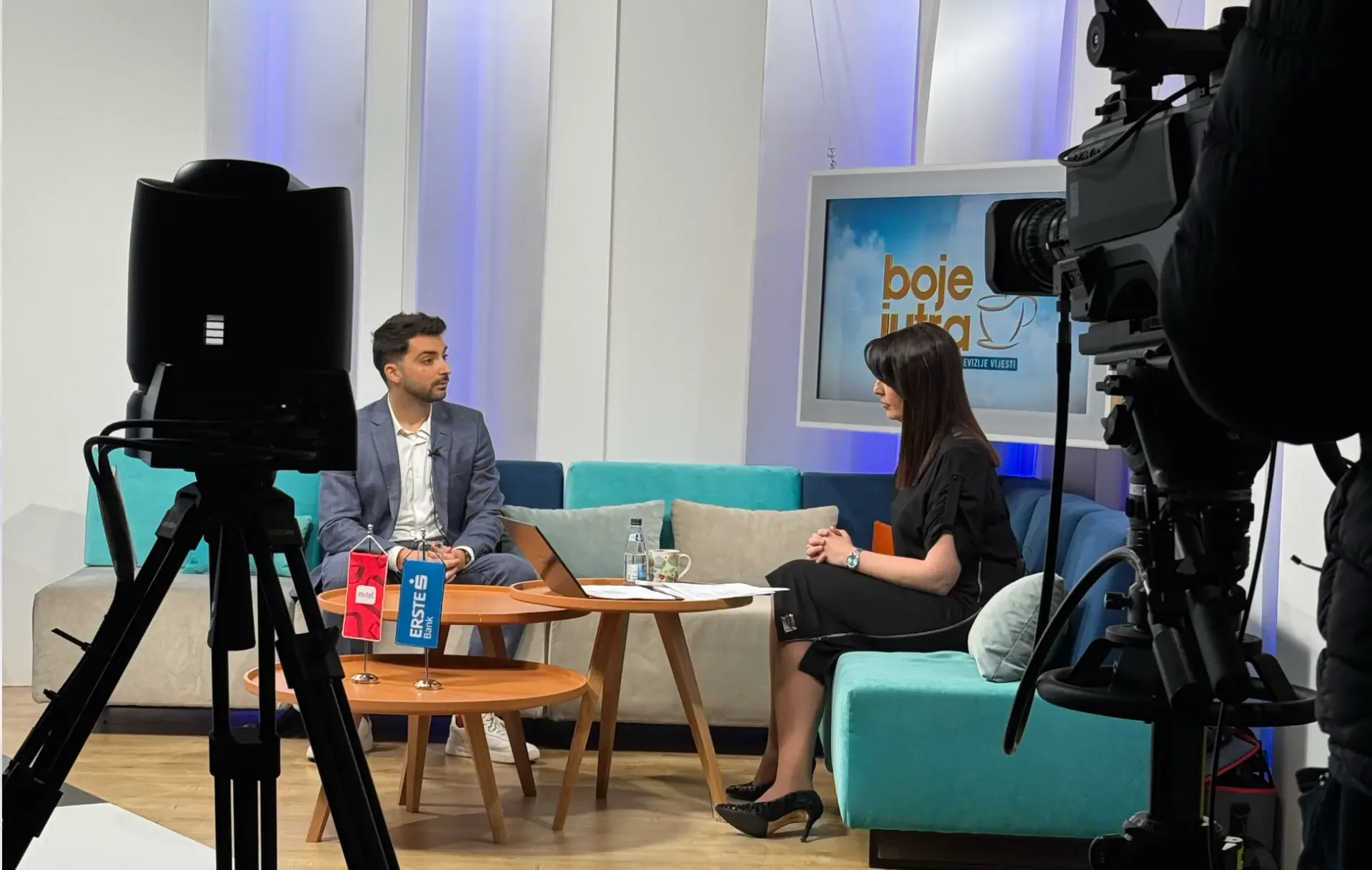

On Vikend popodne on Televizija E we talked about tech entrepreneurship and cybersecurity: how I got into the field, the ISO 27001 standard, building a startup in the AI era, the controls that stop most attacks, privacy awareness and simulated attacks on companies.

Vikend popodne, Televizija E
From neighbourhood computers to cybersecurity
I got into computers at 12 or 13, when we went from one neighbour to another depending on who had the better Pentium and which games it could run. We still paid for the internet by the hour. I opened the cases to see what was inside and caused a few short circuits.
When I enrolled at the Faculty of Electrical Engineering in Podgorica, it was clear I would work in information technology. Cybersecurity came up early, at my first employer. It was not developed enough here, and I saw that focusing on it could open doors much faster.
Information security starts with what you value
Our photos and videos are our history and our memories, and we probably value them above anything else on our phones and computers. A ransomware attack encrypts them and demands money, and many people have paid because they had only one copy. Information security means preparing for such attacks, starting with backups in several places, such as a cloud photo service or an external hard drive.
For a company the principle is the same. You decide what you cannot afford to lose and protect that first.
ISO 27001 as a sales tool
I have worked on compliance with regulations and international standards for 12 to 13 years. The best known standard in Europe is ISO/IEC 27001. Its technical, people and process controls tell you what to implement to reach a high level of security and get certified.
The certificate opens the market. We present it to clients as a sales tool that raises the value of a company and its number of clients. If you want to work with a big bank, it can decide whether you are selected for a tender or disqualified.
The controls that matter most
In my view, five or six of the controls in ISO 27001 protect you from more than 90% of attacks, because most attacks arrive by email as phishing.
Protect your email
Start with anti-phishing filters that are more advanced than the standard ones. Filters do not help with invoice fraud, because such an email is legitimate in form. It carries an invoice for some amount and no virus to catch. What protects you is process control. Before you pay, check the contract, the account number and the address, especially when the account has changed.
This happened to Airports of Montenegro. Thanks to the way payments pass through intermediary banks abroad, the payment to the attacker was stopped before the money was lost.
Protect your accounts
Use complex passwords and two-factor authentication. Setting it up takes a few seconds, and you can require it for every account through an identity management system. It is the first thing we check. If you do not have it, please sort it out today.
Train people for their own job
Education has to be continuous, because technology develops fast. Security awareness training is part of the ISO standard, and it works best when you tailor it to each department. Finance learns about invoice fraud. Management learns about fake emails that seem to come from partners, employees or the assistant of a director and try to take over an account.
How one phishing email becomes a company-wide incident
- An email tells you to reset your Google password urgently. The link opens a fake Gmail or Outlook login page, and its address can use look-alike characters, even a Cyrillic O.
- You enter your password and your two-factor code, and with that you hand your session to the attacker.
- From your real address the attacker targets your colleagues, who are far more likely to trust a message from inside. The attacker can also go after the IT administrator with privileged access and take control of the company with that account.
If that happens even though you had email filters and two-factor authentication, the third part of your defence, education, was not effective enough.
Test how vulnerable you are
You can find out how vulnerable your company is through penetration testing or a red team engagement. Certified ethical hackers simulate a complete attack through phishing and login screens and, if you want it, physical entry. Social engineering often works because people want to help. With a copied ID badge and a story about your first day, a security officer walks you in through the main door. Afterwards you document every entry point and how to close it, and you run a re-test.
Starting a startup is easier and harder than ever
AI tools let one person build a company. With vibe coding, or programming with words, you tell the AI what to build and it writes the code, so you can make a complete mobile or web application on your laptop. That takes around 200 to 300 euros a month in subscriptions and credits, which is still very cheap.
The hard part is that everyone can do the same, so the competition is huge. While I am still thinking about an idea, someone is already building it.
We started Secfix in Munich five years ago, before these tools existed. When they arrived and competitors could build faster what we had developed the hard way, we had to choose. We changed how the whole company works. Every employee uses AI tools and spends the time saved on creative work. We did it to stay in the race, and we are still in it.
Privacy awareness in Germany and in Montenegro
When I moved to Munich, I saw how highly Germans value data privacy. If your website asks for data it does not need, people there will email you to ask why.
Here, people will give everything to get a service, especially in a prize game or when applying for something free. Awareness of how cheaply we trade our personal data is very low, and that is where every company can start with its own employees.
Passion and daily learning
Passion for what you do drives motivation, motivation drives action and action brings results. For me that passion is a hunger for knowledge. Every morning I spend an hour or two reading what is new, and I try every new tool as it comes out.
There is so much free material online that anyone can start a career in IT. The introductory courses of our academy in information security are free and always will be.
Where this first appeared
InterviewTelevizija E21 Feb 2026
Watch the interview on Vikend popodne (in Montenegrin)Write-updzakula.com21 Feb 2026
Read the full conversation on dzakula.com
See what your company has left exposed.
Request a trial