
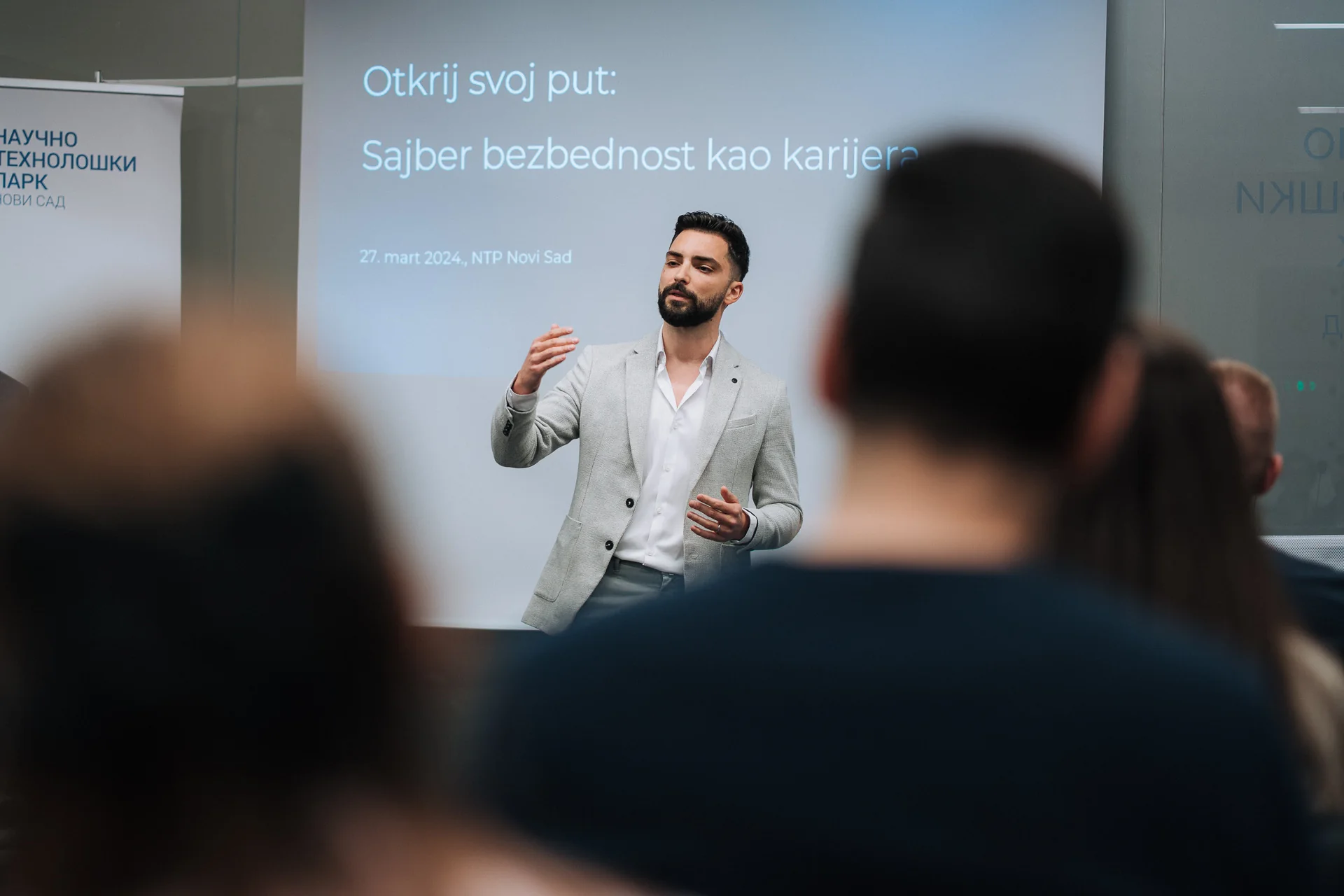
In an interview for Forbes Srbija I talked about two things that are missing at the same time, the experts and the awareness. The world is short more than four million cybersecurity professionals, and demand keeps growing. Cybersecurity needs specialised skills built through years of practice, and education and training cannot keep up with the speed at which technology and threats develop.
The good side of that arithmetic is that information security is one of the most durable career paths available.
What attackers use
According to research by Verizon that was new at the time, nearly 80% of successful attacks worldwide involve email phishing, so that is where you start. Ransomware, DDoS and the exploitation of vulnerabilities in software and systems follow.
Three trends were already visible in 2024:
- Generative AI is used to mass-produce phishing emails tailored to each victim, which raises the chance that someone clicks or gives away credentials.
- Deepfake technology is used for mass fraud and for peer bullying of minors, with content made from the likeness of a victim to humiliate them.
- Anonymity technologies were misused to send bomb threat hoaxes by email around the world.
Four measures that cost nothing
- Configure your accounts correctly.
- Make multi-factor authentication mandatory.
- Use strong passwords.
- Teach employees to recognise a phishing email and tell them where to report it.
Most of your risk can be reduced or removed with these four measures. None of them needs a security team or a budget.
IT staff are not automatically security staff
Putting people without the right expertise in key positions can lead to data loss, financial loss and damage to your reputation. I see three causes.
- Organisations lack the expertise to assess the skills of a candidate in an interview, so junior people end up in highly responsible roles.
- Management does not recognise that IT staff need training to specialise in security.
- Many assume that IT staff know security because the fields are related, and assign them security work without that training.
Expensive software is not necessarily good software
Under budget pressure, institutions sometimes buy cheaper software of lower quality. The opposite mistake is just as common. There is a growing number of expensive products with premium design and disappointing results.
Test every solution thoroughly before you roll it out. If you do not have the people to test and run it, a managed security service provider can handle testing, implementation and ongoing management for a monthly subscription. The greater risk is failing to invest in people, because skilled people are the foundation of good security practice.
The minimum for remote work
In 2020, as CISO at Kaia Health, I moved a healthcare company to remote work in a few days. The data we handled every day was highly sensitive, and the roadmap could not slow down. This is the minimum I recommended then, and it still holds for small and medium-sized businesses, because it keeps security high with very little investment.
- Strong user authentication, from single sign-on to two-factor authentication for all systems, and especially for the business-critical ones.
- Protected devices. Laptops that employees take home need disk encryption and endpoint protection.
- A VPN for connecting to company resources from remote locations.
I also learned that change can be implemented very quickly under pressure. After that year there is no justification for postponing digital transformation, or security.
How we answered the shortage of people
Companies respond to the shortage with partnerships with schools and universities, internships, investment in training and certification, and better working conditions.
The UN1QUELY Cyber Security Centre ran into the shortage in its first year. We answered by founding our own academy, where we train new people and hire them when they finish. More than two hundred people have entered the profession that way, and the academy is free.
The lasting solution needs the private sector, the public sector and universities to build one chain of education from secondary school to lifelong learning, so that older workers can retrain into the field as well.
What the rules ask for
Protection systems have to follow the laws on personal data protection and information security, and standards such as ISO 27001, GDPR and NIS2. Regulation has to be updated continuously to keep up with new threats and technologies. NIS2 defines obligations for critical sectors, which are energy, transport, banking, financial markets, health, water management and digital infrastructure. It also covers important sectors such as public administration, the manufacturing of certain goods, digital services, postal and courier services, waste management and food production and distribution. Cloud providers, online marketplaces and search engines have to manage risk, secure their networks and report incidents to national authorities.
Supervision is still missing
The number of information security inspectors is too small to cover the sectors that need supervision. That raises the risk of attacks and encourages companies to neglect compliance. GDPR showed what happens when inspection lags behind the law.
Awareness is the second shortage
Alongside the shortage of experts, the major problem is low awareness of why cybersecurity matters. Many organisations still do not give it enough attention, and the four free measures above are the fastest way to change that in your own company.
Where this first appeared
InterviewForbes Srbija29 May 2024
Read the Forbes Srbija interview (in Serbian)ConversationHead In The Clouds23 Nov 2020
Watch the Head In The Clouds conversation on remote work security
See what your company has left exposed.
Request a trial