
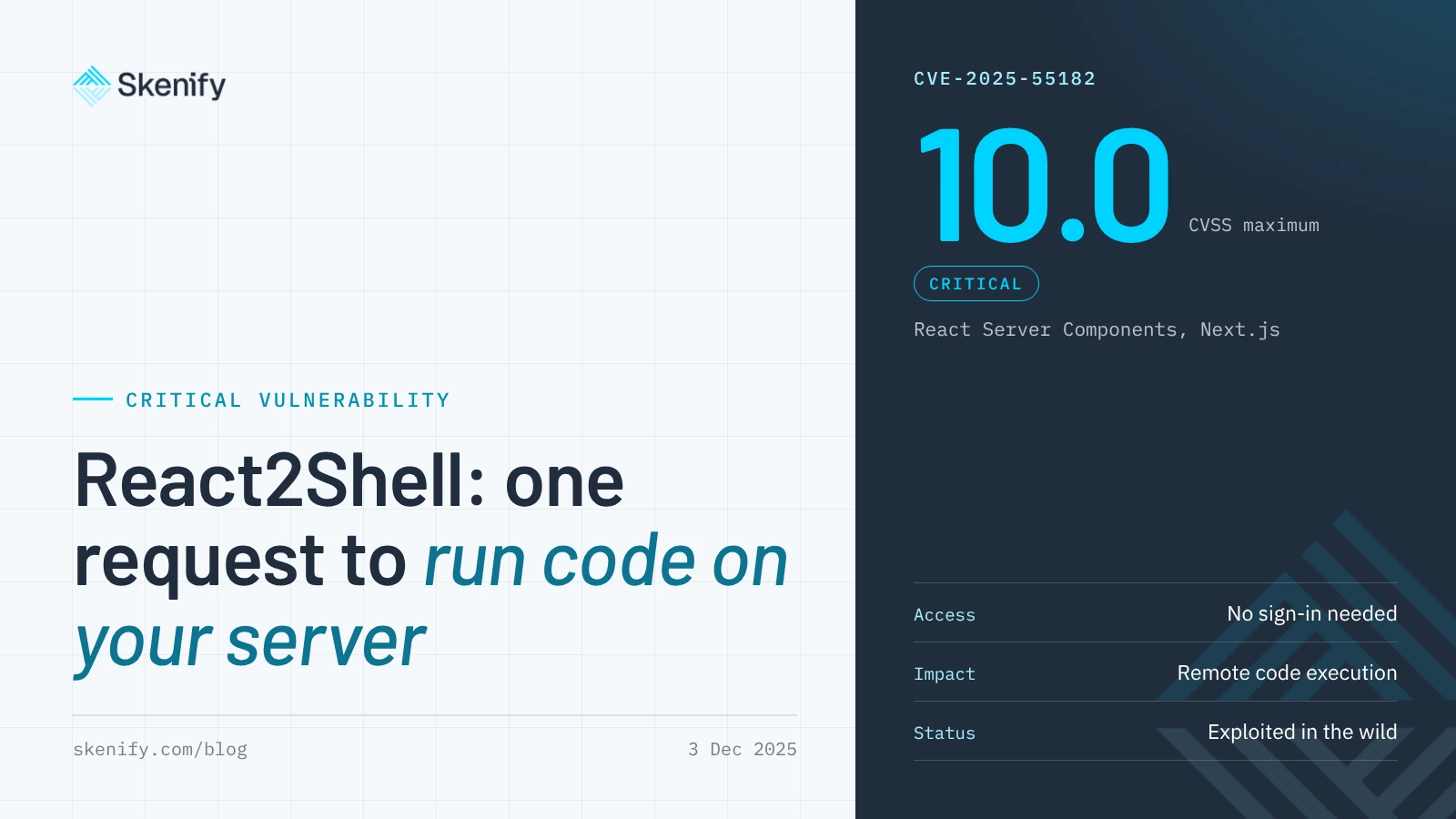
On 3 December 2025 the React team disclosed CVE-2025-55182, a remote code execution vulnerability in React Server Components with the maximum CVSS score of 10.0. The security community named it React2Shell. A single crafted HTTP request lets an attacker who is not signed in run code on the server.
What made it so serious
- No authentication. The attacker needs only network access to the application.
- Default configurations were vulnerable. An application could be exposed even if it never defined a Server Function endpoint.
- Reach. It affected frameworks that embed React Server Components, above all Next.js with the App Router.
- Speed. A working proof of concept was public on 4 December 2025, one day after disclosure, and exploitation followed within hours.
The timeline
- 29 November 2025: researcher Lachlan Davidson reports the flaw to Meta.
- 3 December 2025: coordinated public disclosure and patches.
- 4 December 2025: a proof of concept is published.
- 11 December 2025: further React Server Components vulnerabilities are disclosed, which require another upgrade.
Who was affected
- The packages react-server-dom-webpack, react-server-dom-parcel and react-server-dom-turbopack in versions 19.0.0, 19.1.0, 19.1.1 and 19.2.0.
- Fixed in React 19.0.1, 19.1.2 and 19.2.1.
- Next.js fixes: 15.0.5, 15.1.9, 15.2.6, 15.3.6, 15.4.8, 15.5.7 and 16.0.7.
What to do if you still run an affected version
- Upgrade React and Next.js to the latest patch release of your branch, which also covers the vulnerabilities disclosed after 3 December.
- Redeploy every environment, including staging and preview deployments that face the internet.
- Review server logs from December 2025 onward for unusual POST requests, and rotate secrets the application could read.
The lesson for a company without a security team
React2Shell did not require a mistake by your developers. The flaw arrived with a dependency, and the time between disclosure and attack was measured in hours. The companies that handled it well knew which of their internet-facing applications ran the affected stack and could patch the same day. A current inventory of what you expose to the internet is what makes that possible.
Sources
Referencereact2shell.comDec 2025
React2Shell (CVE-2025-55182), by the researcher who reported itAnalysisRapid74 Dec 2025
Critical unauthenticated RCE affecting React Server Components
On Skenify
See which of your internet-facing systems are exposed, with every finding confirmed on the live asset.
Request a trial