
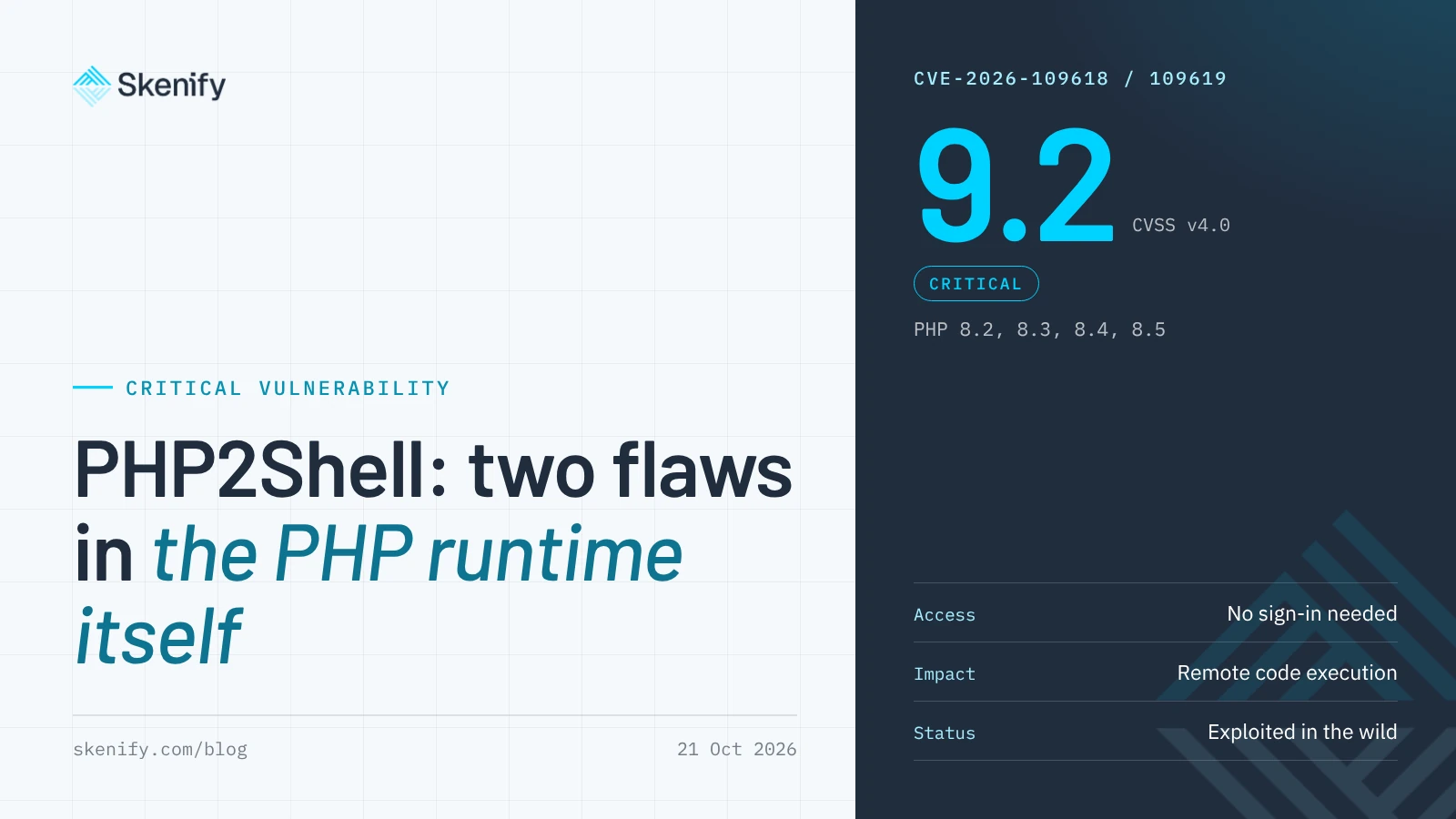
On 21 October 2026 the PHP project released emergency security updates for two vulnerabilities in the PHP runtime, CVE-2026-109618 and CVE-2026-109619. Researchers call the pair PHP2Shell. Both are rated 9.2 on CVSS v4.0, and both can allow remote code execution without authentication, with the privileges of the web worker.
Why this one is different
Most web vulnerabilities sit in an application or a plugin. These sit in the language runtime, so the application code does not need a bug of its own. PHP runs a large share of websites, and it is also built into the management interfaces of many network appliances, where only the vendor can update it.
Who is affected
- PHP 8.2 before 8.2.35, 8.3 before 8.3.36, 8.4 before 8.4.27 and 8.5 before 8.5.12.
- PHP confirmed remote code execution against Apache mod_php. PHP-FPM should be treated as exposed as well.
- Appliances and products that embed PHP, until their vendors ship firmware fixes.
What to do
- Find every place PHP runs, including servers you rarely touch and appliances with web interfaces.
- Update PHP to 8.5.12, 8.4.27, 8.3.36 or 8.2.35.
- Restart the PHP workers so the new version is loaded.
- Apply vendor firmware updates for appliances as they are released, and keep their management interfaces off the internet.
CISA added both CVEs to its Known Exploited Vulnerabilities catalogue on 26 October 2026.
Sources
AnalysisRapid721 Oct 2026
Critical unauthenticated remote code execution in PHPAdvisoryPHP21 Oct 2026
PHP security advisory, 21 October 2026
On Skenify
See which of your internet-facing systems are exposed, with every finding confirmed on the live asset.
Request a trial